
BAMS Admission Guide 2026
BAMS Admission 2026 —
AACCC Counselling, Top Colleges,
Surgical Rights & Career ROI
📌 Related pillar guides: Medical Colleges in India · NEET 2026 · Govt Medical Colleges
BAMS is no longer a backup to MBBS. Ministry of AYUSH reforms, 58 authorised surgical procedures for MS Ayurveda graduates, and a $5 trillion global wellness market have transformed this into a primary career choice. NIA Jaipur, BHU Varanasi, AIIA Delhi — at ₹25K–45K/yr fees — vs private BAMS at ₹2.5L–4.5L/yr. Get the complete 2026 AACCC counselling and career guide.
By Krishna Pandey, Founder & Lead Counsellor
✅ Sourcing: figures use official counselling records (MCC/state) and institute circulars — cutoffs change every round; reconfirm at allotment. No cash payments; official receipts only.
Why BAMS is a Primary Career Choice in 2026
The Surgical & Clinical Revolution
CCISM 2020 notification granted BAMS postgraduates (MS Shalya Tantra) legal authority to perform 58 specific surgeries — hernia repair, appendectomy, cataract surgeries, haemorrhoid procedures. Clinical parity with MBBS has never been closer for surgical specialists.
The Global Wellness Boom
The $5 trillion global wellness industry is growing 9.9% annually. BAMS graduates lead luxury wellness retreats in the Maldives and Europe, consult for Patanjali, Himalaya, and Apollo Wellness, and run Panchakarma centres where consulting fees are charged in Dollars and Euros.
Debt-Free Graduation
Government Ayurvedic Colleges: ₹15K–40K/yr total. Even the most expensive private BAMS colleges cap at ₹15–20L total course cost — vs ₹80L–1Cr for private MBBS. You start practice debt-free and pursue MS/MD Ayurveda without loan pressure.
BAMS Seat Matrix & Counselling Structure
AACCC — The 15% AIQ Gateway
Ayush Admissions Central Counselling Committee (aaccc.gov.in)
- 15% AIQ from all Govt/Aided colleges nationwide
- 100% of National Institutes (NIA, AIIA) via AACCC
- 100% of Deemed University seats via AACCC
- Based on NEET AIR (All India Rank)
State AYUSH Counselling — The 85% Gateway
Each state conducts separate AYUSH counselling
- 85% of seats in Govt and Private Ayurvedic colleges
- Usually reserved for state domicile candidates
- Some states (Karnataka, UP) allow outsiders for private BAMS
- Starts ~2 weeks after MCC MBBS counselling
BAMS Cutoff 2026 — Premier Government Ayurvedic Institutes (indicative NEET safe scores)
These colleges represent the gold standard of Ayurvedic education. A seat here requires a NEET score that often exceeds many private MBBS cutoffs. The indicative 2026 "Safe NEET (AIQ Gen)" scores below are AACCC All-India-Quota benchmarks — verify the official closing ranks on the AACCC portal each round.
Compare these BAMS cutoff figures with the NEET 2026 cutoff and counselling schedule, see the related BDS admission cutoff guide, and if your score is on the lower side review the low NEET score MBBS & AYUSH cutoff guide to map your rank to the right college tier.
📌 In one line: official closing data — year/category labeled; verify the current round on the official portal.
| # | College | City | Safe NEET (AIQ Gen) | Annual Fee | Key Edge |
|---|---|---|---|---|---|
| 1 | IMS, Banaras Hindu University (BHU) | Varanasi | 560–580+ | ₹32,000 | Highest Ayurveda research output in Asia |
| 2 | All India Institute of Ayurveda (AIIA) | New Delhi | 550–570+ | ₹35,000 | "AIIMS of Ayurveda" — apex national institute |
| 3 | National Institute of Ayurveda (NIA) | Jaipur | 545–565+ | ₹45,000 | Premier surgical Ayurveda training |
| 4 | ITRA (Inst. of Teaching & Research in Ayurveda) | Jamnagar | 530–550+ | ₹25,000 | Global WHO collaborative centre |
| 5 | RA Podar Ayurved Medical College | Mumbai | 540–560+ | ₹55,000 | Legacy hospital, massive patient load |
| 6 | State Ayurvedic College & Hospital | Lucknow | 525–545+ | ₹15,000 | Top choice for North India state quota |
| 7 | Government Ayurveda College | Trivandrum | 530–550+ | ₹12,000 | Authentic Kerala Panchakarma base |
| 8 | JB Roy State Ayurvedic Medical College | Kolkata | 515–535+ | ₹10,000 | One of India's oldest Ayurveda colleges |
| 9 | Government Akhandanand Ayurved College | Ahmedabad | 510–530+ | ₹15,000 | Excellent clinical infrastructure |
| 10 | Government Ayurveda College Thiruvananthapuram | Kerala | 505–525+ | ₹12,000 | Strong PG pipeline — MS Ayurveda |
Table 2: Top Private BAMS Colleges — ROI & Infrastructure
For students scoring 250–480, these private institutions offer modern diagnostic labs and clinical training comparable to mid-tier hospitals.
| College | City | Type | Annual Fee | Safe NEET Score |
|---|---|---|---|---|
| Patanjali Ayurved College | Haridwar | Private | ₹2,50,000 | 420–460+ |
| SDM College of Ayurveda | Udupi | Private | ₹3,00,000 | 380–420+ |
| D.Y. Patil Ayurved College | Pune | Deemed | ₹4,50,000 | 260–300+ |
| Bharati Vidyapeeth Ayurved College | Pune | Deemed | ₹3,75,000 | 230–280+ |
| Amrita School of Ayurveda | Amritapuri (Kerala) | Deemed | ₹4,20,000 | 300–350+ |
| Sree Narayana Institute of Ayurveda | Kerala | Private | ₹2,80,000 | 350–400+ |
| Major SD Singh Ayurved Medical College | Farrukhabad (UP) | Private | ₹2,60,000 | 200–240+ |
| Shree Swaminarayan Gurukul Ayurved College | Gujarat | Private | ₹3,10,000 | 250–290+ |
AACCC Security Deposit & Exit Rules
Financial Commitment
- Govt/Govt-Aided Seats: ₹10,000 refundable + ₹1,000 non-refundable
- Deemed Universities: ₹50,000 refundable + ₹5,000 non-refundable
- Deposit returned after 4 months if no seat allotted
- Adjusted against fees if seat taken
The Exit Trap
- Round 1: Free Exit allowed
- Rounds 2 & 3: NO FREE EXIT. Allotted + not joined = deposit forfeited
- Stray Vacancy: not joining = disqualified from NEET counselling next year
Step-by-Step BAMS Admission Roadmap 2026
Online Registration (aaccc.gov.in)
Register using NEET roll number. 12th PCB aggregate must be 50% (Gen) or 40% (Reserved). Pay registration fee and security deposit in one session.
Choice Filling — Hospital OPD Strategy
Don't just rank colleges by name — check the hospital OPD patient numbers and surgical OT availability. A BAMS college without a busy hospital is a degree without clinical value. Prioritise: NIA, AIIA, BHU, then state government colleges, then private.
Round-Wise Seat Allotment
Seat allotted based on NEET AIR. If allotted, download letter and physically report to college for document verification + fee payment within the deadline.
Internal Upgradation Option
Accept Round 1 allotment (College #10) and opt for upgradation in Round 2. If Round 2 gives College #3, accept it — College #10 seat is released back. If no improvement, College #10 seat is auto-confirmed. Safe strategy: always take admission, then upgrade.
Life After BAMS — MD/MS and Global Career Tracks
AIAPGET — PG Entrance
After 1-year internship, appear for All India AYUSH PG Entrance Test. MS Ayurveda (Shalya Tantra) = surgical specialist path. MD Ayurveda (Kayachikitsa/Panchakarma) = medicine/wellness path. Both open ₹25–60L/yr income brackets.
Integrated Practitioner
Many BAMS graduates work as RMOs at Apollo, Fortis, and Max hospitals. In Maharashtra and UP, bridge course rights allow integrated medicine practice. Corporate wellness chains (Kaya Clinic, Body Wise) actively hire BAMS doctors.
Medical Tourism & Global Wellness
India is the global capital of Medical Tourism. BAMS specialists in Panchakarma and Yoga head wellness centres in Switzerland, Germany, UAE, and the USA — consulting in Dollars and Euros. Starting income: ₹5–8L equivalent/month for senior roles.
Document Checklist — BAMS Admissions 2026
Academic & Identity
- NEET UG 2026 Admit Card + Scorecard
- AACCC / State Allotment Letter
- 10th & 12th Marksheets + Passing Certificates
- Transfer Certificate + Migration Certificate
- Aadhaar Card + 8 passport photos
- Gap Certificate (if drop year taken)
Category & Medical
- Caste Certificate + Validity (CVC if MH/Bihar)
- Non-Creamy Layer Certificate (OBC — valid 2026-27)
- Medical Fitness Certificate (Civil Surgeon)
- EWS Certificate (if applicable)
Is BAMS harder than MBBS?
In many respects, yes. BAMS students study the complete modern medical curriculum — anatomy, physiology, pathology, pharmacology — at the same depth as MBBS. Additionally, they study ancient Ayurvedic texts, Sanskrit shlokas, and classical Ayurvedic formulations. The dual-curriculum nature makes BAMS a demanding degree. The NEET cutoffs for top government Ayurvedic colleges (BHU, NIA, AIIA) reflect this — they are often higher than many private MBBS management quota cutoffs.
Can BAMS doctors perform surgery?
Yes — legally, BAMS postgraduates who complete MS Ayurveda (Shalya Tantra specialisation) are authorised to perform 58 specific surgical procedures as per the 2020 gazette notification (originally issued by CCIM, now under the National Commission for Indian System of Medicine — NCISM, which replaced CCIM in 2021). These include hernia repair, appendectomy, haemorrhoid surgeries, and certain abdominal procedures. The legality has been tested in courts and upheld. A general BAMS (without MS Surgery specialisation) practices within the Ayurvedic scope — the surgical rights require the 3-year MS postgraduate degree.
Is the bridge course for BAMS active?
It varies by state. In Maharashtra, BAMS doctors can practise modern medicine if they clear a state-approved pharmacology bridge course. In UP, integrated medicine practice within AYUSH regulations is recognised. At the national level, the issue remains under legal challenge — the IMA has contested bridge course expansion, and courts have issued varying orders. Always verify the current legal status in your state of practice before relying on bridge course rights for your career plan. FindUrCollege tracks this regulatory environment and advises accordingly.
What is the salary of a BAMS doctor in 2026?
A fresher in a private clinic or corporate wellness chain earns ₹40,000–60,000/month. A government BAMS doctor (AYUSH officer at PHC/CHC) earns ₹55,000–80,000/month with job security and benefits. Specialised MS/MD Ayurveda practitioners with a private practice or working in a corporate wellness chain can earn ₹1.5L–4L/month. Panchakarma specialists and Yoga-integrated practitioners at premium wellness centres (Ananda, Kairali, luxury resorts) can charge ₹3,000–10,000 per consultation. International wellness practitioners earn equivalent of ₹5–12L/month.
Can I get an education loan for BAMS?
Yes. BAMS is a recognised professional clinical degree under the National Commission for Indian System of Medicine (NCISM). All nationalised banks — SBI, Bank of Baroda, PNB — provide education loans up to ₹15L for BAMS, often without requiring large property collateral (since the total course cost is modest). For deemed university BAMS (DY Patil, Bharati Vidyapeeth), loans up to ₹25L are available with co-applicant income proof. Interest rates are typically the same as MBBS loans (8.5–11% depending on the bank and your profile).
Book Your Free 2026 BAMS Strategic Roadmap Session
Whether you're targeting NIA Jaipur with a 540 score or finding the best private BAMS ROI with a 300 score — our counsellors will map your NEET rank to the best AACCC college tier and career pathway.
Or call/WhatsApp directly: +91 91126 50438 | Mon–Sun 9am–10pm IST
Legal Disclaimers
FindUrCollege provides educational guidance only and is not affiliated with NCISM, the Ministry of AYUSH, AACCC, or any Ayurvedic college. BAMS surgical rights are subject to ongoing legal interpretation and vary by state — verify current court orders before making career decisions based on surgical scope. Fee ranges and NEET cutoffs are indicative based on prior session data. Bridge course availability is state-specific and legally contested — do not rely on it without current legal verification. FindUrCollege does not facilitate cash seat purchases or capitation fees. All payments must be to official institutional bank accounts.
Expert Tips — BAMS Admission 2026
- Don't treat BAMS as only a "backup" for MBBS — choose it intentionally: Students who study BAMS while wishing they were in MBBS typically struggle with motivation and often don't maximise the programme. BAMS is best for students genuinely interested in Ayurvedic medicine, holistic health, and traditional medicine systems. If you are genuinely passionate, BAMS offers a fulfilling and financially rewarding healthcare career.
- Target government Ayurveda colleges first — the fees are extraordinary value: BHU Faculty of Ayurveda at ₹15,000/year is one of the best professional degrees per rupee in India. NIA Jaipur and GAU Jamnagar at ₹20,000–25,000/year are similar. If your NEET score (400–500+) can get you into these institutions through state or AIQ counselling, it is dramatically better value than paying ₹2–3 lakh/year at a private Ayurveda college.
- Apply to multiple state AYUSH counsellings if domicile allows: If you have Maharashtra domicile, apply to Maharashtra AYUSH counselling. But also register for Karnataka AYUSH, Rajasthan AYUSH, and UP AYUSH if your NEET score qualifies — some states allow non-domicile applications for AIQ seats. Having multiple state applications maximises your chances of government college access.
- Start planning for AIAPGET from 3rd year of BAMS: The best BAMS graduates begin reviewing MD Ayurveda entrance topics from Year 3 onwards. AIAPGET is comprehensive — it tests all BAMS subjects. Early preparation converts the final year BAMS academic load into simultaneous MD entrance preparation.
- Consider Panchakarma specialisation for international wellness careers: If you have interest in wellness tourism and international careers, develop Panchakarma skills during your BAMS internship. Kerala, Goa, Rajasthan, and Uttarakhand wellness resorts, and international Ayurvedic centres in Germany, the UK, and the UAE actively hire BAMS doctors with clinical Panchakarma expertise.
For BAMS admission guidance — state AYUSH counselling strategy, government Ayurveda college targets, or management quota at private BAMS colleges — contact FindUrCollege: WhatsApp +91 91126 50438.
BAMS State-wise Seat Distribution and Counselling Authorities 2026
BAMS seats are distributed across multiple states. Here is a guide to states with the most BAMS seats and their counselling processes:
📌 In one line: branch-wise seats & options at a glance.
| State | Approx. BAMS Seats | Counselling Authority | Key Colleges |
|---|---|---|---|
| Maharashtra | ~5,000+ | Maharashtra AYUSH State CET Cell (DMER/AYUSH) | Tilak Ayurved Mahavidyalaya Pune, Sumatibhai Shah Pune, SDM, Shri Jagdamba Ayurvedic College |
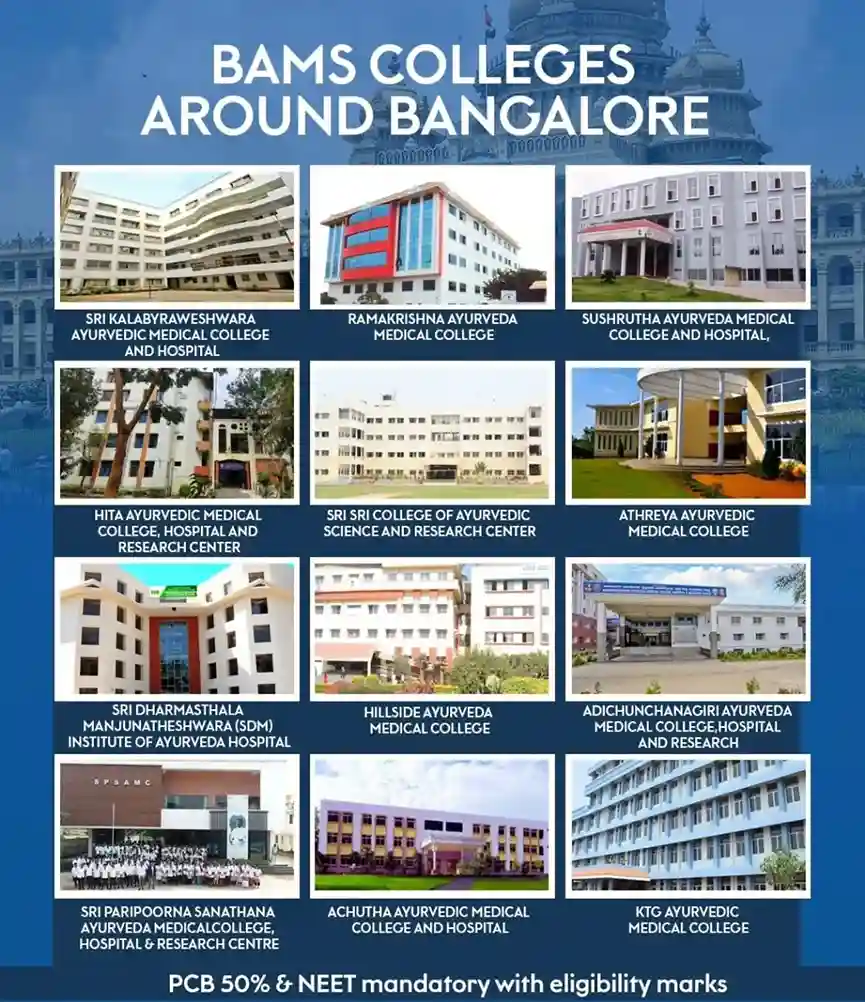
| Karnataka | ~4,000+ | KEA (Karnataka Examinations Authority) | SDM College Udupi, RGUHS affiliated colleges, Government Ayurveda Medical College Bengaluru |
| Rajasthan | ~4,500+ | Rajasthan AYUSH Directorate | National Institute of Ayurveda Jaipur, SN Medical College Government, Dr. S.N. Medical College |
| Uttar Pradesh | ~5,000+ | DGSM UP (Directorate General State Medical UP) | BHU Faculty of Ayurveda, Rajkiya Ayurvedic College Varanasi, and numerous private colleges |
| Gujarat | ~3,000+ | ACPUGMHS (Admission Committee for Professional Under Graduate Medical Homeopathic and Ayurvedic Courses) | Gujarat Ayurved University (GAU) Jamnagar, IPGT&RA, private Ayurveda colleges |
| Madhya Pradesh | ~3,500+ | MP AYUSH Directorate | Government Ayurvedic College Bhopal, Government Ayurvedic College Gwalior, numerous private colleges |
Maharashtra and Uttar Pradesh have the most BAMS seats in India. Karnataka's KEA conducts a transparent, merit-based BAMS counselling process. Rajasthan's NIA Jaipur (government, premier) is highly competitive. Gujarat Ayurved University at Jamnagar is India's oldest Ayurveda university and a globally respected institution for Ayurvedic education — their BAMS programme is considered among the best in the world for classical Ayurveda training.
BAMS Curriculum — 4.5 Years of Study Overview
The BAMS curriculum is prescribed by the National Commission for Indian System of Medicine (NCISM, which replaced CCIM in 2021) and covers both Ayurvedic classical subjects and modern medical sciences:
| Year | Ayurvedic Subjects | Modern Medical Sciences | Clinical |
|---|---|---|---|
| Year 1 | Padartha Vigyana (Ayurvedic philosophy), Maulik Siddhanta, Sanskrit | General Anatomy, General Physiology, General Biochemistry | Introduction to Ayurvedic clinical assessment |
| Year 2 | Dravyaguna (Ayurvedic Pharmacology), Rasa Shastra (Ayurvedic pharmaceutics), Agada Tantra (toxicology) | Pathology, Microbiology, Pharmacology | Preliminary clinical — herbarium study |
| Year 3 | Charak Samhita study, Sushrutha Samhita study, Kayachikitsa (Internal Medicine) | Surgery basics, Forensic Medicine | Clinical rotations — Kayachikitsa (OPD/IPD) |
| Year 4 | Shalya Tantra (Ayurvedic Surgery), Shalakya Tantra (ENT/Ophthalmology), Prasuti Tantra (Gynecology), Panchakarma | ENT, Ophthalmology, Gynecology, Paediatrics | Clinical rotations across all departments |
| Year 5 (Internship) | Rotating internship across all BAMS departments | Modern medicine rotation in attached hospital | Full clinical — patient care with supervision |
The BAMS curriculum uniquely combines classical Ayurvedic texts (Charak Samhita, Sushruta Samhita, Ashtanga Hridayam) with modern medical sciences (anatomy, physiology, biochemistry, pathology, pharmacology). This integrated approach gives BAMS graduates both traditional Ayurvedic expertise and foundational understanding of modern medical principles — valuable for both clinical practice and cross-disciplinary research.
For complete BAMS admission guidance — college selection, state counselling strategy, management quota, and financial planning — contact FindUrCollege at WhatsApp +91 91126 50438.
The Future of AYUSH in India — Why BAMS Has Strong Long-term Prospects
The Government of India has significantly invested in the AYUSH sector over the past decade. The AYUSH Ministry (Ministry of Ayurveda, Yoga and Naturopathy, Unani, Siddha and Homeopathy) has a dedicated national budget that has grown significantly. Key factors making BAMS a strong long-term career choice:
- National AYUSH Mission: Launched in 2014, the National AYUSH Mission funds AYUSH health infrastructure, colleges, hospitals, and research programmes across India. Over 6,000 AYUSH health and wellness centres are being established as sub-centres under the government's Ayushman Bharat programme — creating significant demand for BAMS graduates as primary healthcare providers.
- COVID-19 effect on Ayurveda acceptance: Post-COVID, consumer interest in immunity-boosting Ayurvedic formulations, preventive Ayurvedic protocols, and Panchakarma detox treatments has increased dramatically. Multiple published studies on Ayurvedic COVID management have elevated Ayurveda's credibility in mainstream health discourse.
- Global Ayurvedic wellness market: The global Ayurvedic products market was valued at approximately USD 10 billion in 2023 and is projected to reach USD 20–25 billion by 2030. This growth creates demand for Ayurvedic doctors at premium wellness destinations globally, particularly in Europe, the Middle East, Southeast Asia, and North America.
- Integration with mainstream healthcare: AIIMS Delhi, AIIMS Rishikesh, and several central hospitals have integrated AYUSH OPDs alongside allopathic departments. This mainstreaming signals official recognition of AYUSH medicine's role in India's healthcare system — creating institutional career paths for BAMS graduates within the conventional healthcare system.
- AYUSH entrepreneurship: The startup ecosystem has embraced Ayurveda — companies like Kapiva, VAHDAM, Forest Essentials, Kama Ayurveda, Biotique, Mamaearth (traditional ingredients), and dozens of new AYUSH startups are creating non-clinical career opportunities for BAMS graduates with entrepreneurial inclinations. Medical advisory, product formulation, clinical research, and regulatory affairs roles at these companies are accessible to BAMS graduates.
BAMS graduates from the 2026–2030 admissions cohort will enter a healthcare ecosystem where AYUSH is increasingly integrated into national and global health systems — a very different and more opportunity-rich landscape than existed a decade ago. For students genuinely drawn to Ayurvedic medicine, BAMS in 2026 is a well-timed career choice.
FindUrCollege provides BAMS admission counselling alongside guidance on AYUSH career paths and postgraduate options. Contact us at WhatsApp +91 91126 50438 for free consultation.
Documents Required for BAMS Admission 2026
- NEET-UG 2026 Scorecard — download from nta.nic.in after result declaration
- NEET-UG 2026 Admit Card — required alongside scorecard for verification
- Class 12 Marksheet — Biology, Physics, Chemistry required (PCB). Minimum 50% for General category in PCB aggregate; 40% for SC/ST
- Class 12 Passing Certificate — board certificate confirming passing Class 12
- Class 10 Marksheet and Certificate — date of birth proof, board record
- Domicile Certificate — for state AYUSH counselling; issued by Tehsildar/SDO of your state
- Caste Certificate (SC/ST/OBC) — if claiming reservation benefit
- Caste Validity Certificate (for SC/ST/OBC in Maharashtra, Karnataka — states that require it) — apply early, takes 4–8 weeks
- NCL Certificate (OBC-Non Creamy Layer) — current year certificate; family income must be below NCL limit
- Aadhaar Card — identity proof, linked to bank account for scholarship disbursement
- Allotment Letter — from AIQ AYUSH counselling or state AYUSH counselling authority
- Medical Fitness Certificate — from a registered medical practitioner or government hospital
- Passport-size Photographs (8–10 copies) — recent, white background
- Gap Year Certificate / Affidavit — if there is a gap year between Class 12 and admission year
For BAMS admissions where state AYUSH counselling is involved, document preparation timelines are similar to other medical admissions. The Caste Validity Certificate for states that require it (Maharashtra, Karnataka) must be applied for well in advance — ideally January 2026. For states where only a caste certificate is required (not scrutiny committee validation), the process is faster. Verify specific document requirements with the state AYUSH counselling authority of your domicile state. Contact FindUrCollege at WhatsApp +91 91126 50438 for state-specific BAMS admission document guidance.
BAMS Admission 2026 — Career After Ayurveda Degree
BAMS (Bachelor of Ayurvedic Medicine and Surgery) is a 4.5-year + 1-year internship professional degree regulated by the National Commission for Indian System of Medicine (NCISM), which replaced the Central Council of Indian Medicine (CCIM) in 2021 under the NCISM Act, 2020. BAMS is the most popular among AYUSH (Ayurveda, Yoga & Naturopathy, Unani, Siddha, Homeopathy) degrees and offers a legitimate medical career path for NEET-qualified students who don't get MBBS seats.
Key Facts
| Parameter | Details |
|---|---|
| Full Form | Bachelor of Ayurvedic Medicine and Surgery |
| Duration | 4.5 years + 1 year compulsory internship |
| Regulated By | National Commission for Indian System of Medicine (NCISM) — replaced CCIM in 2021 |
| Admission Via | NEET-UG score (mandatory since 2021) |
| Total BAMS Seats in India | ~32,000 (government + private) per current NCISM data. Note: the often-cited 52,000 figure represents total AYUSH capacity (BAMS + BHMS + BUMS + Siddha combined) — not BAMS alone. |
| States with Most Colleges | Maharashtra, Karnataka, Rajasthan, UP, Gujarat |
NEET Score for BAMS
| Seat Type | NEET Score (approx.) | Annual Fee |
|---|---|---|
| Government BAMS Colleges | 350-450 marks | Rs 10,000-50,000/year |
| Private BAMS (State Merit) | 280-350 marks | Rs 1-2.5L/year |
| Private BAMS (Management Quota) | 200-280 marks (above qualifying cutoff) | Rs 2.5-6L/year |
Career After BAMS
- Private Clinic: BAMS doctors can legally practice Ayurvedic medicine and surgery. A well-established Ayurvedic clinic can earn Rs 5-15 LPA
- MD (Ayurveda): Postgraduate specialisation through AIAPGET — specialisations in Panchakarma, Kayachikitsa, Shalya Tantra
- Wellness Industry: Ayurvedic hospitals, wellness retreats, spa management — growing sector in India and globally
- Government Health Services: AYUSH dispensaries, AYUSH hospitals in states — government job security
- Pharma/Healthcare: Ayurvedic product companies (Dabur, Himalaya, Patanjali) hire BAMS graduates for medical representative and R&D roles
- Export/International: BAMS graduates are in demand in Germany, Netherlands, and Middle East for integrative medicine practices