
Dr. D. Y. Patil College of Physiotherapy, Pune — BPT Admission 2026 via DPU-CET
Complete 2026 admission guide for Dr. D. Y. Patil College of Physiotherapy, Pimpri, Pune, Maharashtra — affiliation, BPT & MPT programmes, fees, eligibility, admission process and clinical training.
DPU College of Physiotherapy BPT Admission 2026 — Complete Guide
Dr. D. Y. Patil College of Physiotherapy is the physiotherapy institute of Dr. D. Y. Patil Vidyapeeth (DPU), Pimpri, Pune — a Deemed to be University under Section 3 of the UGC Act 1956, accredited NAAC A++ (CGPA 3.64) and a UGC Category-I (Graded Autonomy) university. Established in 2000, the College of Physiotherapy sits on the same Pimpri campus as DPU's NABH-accredited Medical College & Hospital, giving Bachelor of Physiotherapy (BPT) students unusually strong, real-world clinical exposure from early in the course.
✅ Sourcing: figures use official counselling records (MCC/state) and institute circulars — cutoffs change every round; reconfirm at allotment. No cash payments; official receipts only.
For 2026, BPT admission is through DPU's own Online Proctor-Based Entrance Test (DPU-CET / AIAHET), held on 28 June 2026, together with the standard 10+2 (PCB) eligibility — there is no NEET requirement for physiotherapy. The college offers 100 BPT seats and also runs MPT (Master of Physiotherapy) and a Ph.D. in Physiotherapy.
This guide covers everything a 2026 BPT applicant needs for DPU College of Physiotherapy — the affiliating university and approvals, the BPT and MPT programmes on offer, the indicative fee structure, eligibility, the step-by-step admission process, clinical training and the career scope after graduation. All details are compiled from official and authoritative sources and should be re-confirmed on the official website before you apply.
📊 Key Highlights — DPU College of Physiotherapy
| Feature | Details |
|---|---|
| College | Dr. D. Y. Patil College of Physiotherapy (established 2000) |
| Parent university | Dr. D. Y. Patil Vidyapeeth (DPU), Pimpri — Deemed to be University u/s 3, UGC Act 1956 |
| Location | Pimpri, Pune, Maharashtra — same campus as DPU's Medical College & Hospital |
| Programmes | BPT (Bachelor of Physiotherapy); MPT (Master of Physiotherapy); Ph.D. in Physiotherapy |
| BPT duration | 4 years (8 semesters) + 6-month compulsory internship; CBCS |
| BPT intake | 100 seats — 85% General + 15% NRI/PIO/FN/Institutional |
| Entrance (2026) | DPU-CET / AIAHET (Online Proctor-Based) — 28 June 2026; no NEET required |
| Eligibility | 10+2 with Physics, Chemistry, Biology & English (min 50%); 17+ years of age |
| Accreditation | NAAC A++ (CGPA 3.64, 3rd cycle); UGC Category-I; ISO 9001:2015 & 14001:2015 |
| NIRF 2025 (parent DPU) | University #41, Overall #71, Medical #12, Dental #4 |
| BPT fee | ₹3,00,000 (General) / US $5,000 (NRI/PIO/FN/Institutional) — per the official brochure |
🎓 BPT & MPT Programmes at DPU College of Physiotherapy
Dr. D. Y. Patil College of Physiotherapy offers the full physiotherapy academic pathway — undergraduate, postgraduate and doctoral:
- Bachelor of Physiotherapy (BPT) — 4 years + 6-month internship; 100 seats (the flagship UG programme).
- Master of Physiotherapy (MPT) — 2 years (4 semesters), CBCS; 32 seats, with clinical specialisations.
- Ph.D. in Physiotherapy — minimum 3 years, research-based (seats as per vacancies).
💰 DPU College of Physiotherapy Fee Structure 2026
Indicative DY Patil Pune BPT fee structure for the 2026 session. Physiotherapy fees are revised periodically — always confirm the current figure on the official website before any payment:
📌 In one line: Indicative BPT tuition is ₹3,00,000 for the General category and US $5,000 for NRI/PIO/FN/Institutional candidates per the official Information Brochure, and applying costs ₹300 processing plus ₹750–1,000 for the entrance test, with a ₹250 late fee; confirm on the official website whether the tuition figure is annual or full-course, and the latest 2026 amount.
| Category | Indicative BPT Fee |
|---|---|
| BPT tuition — General category | ₹3,00,000 per year |
| BPT tuition — NRI / PIO / FN / Institutional | US $5,000 per year |
| Application (processing + entrance test) | ₹300 processing + ₹750–1,000 test (₹1,050–1,300; +₹250 late) |
- The BPT fee is ₹3,00,000 (General) and US $5,000 (NRI/PIO/FN/Institutional) per the official Information Brochure — confirm whether this is the annual or full-course tuition, and the latest 2026 figure, on the official website.
- The processing fee (₹300) and entrance-test fee are non-refundable; a late fee of ₹250 applies after the last date.
- Tuition typically excludes hostel, examination and other charges — ask the college office and check for any scholarship or education-loan support.
🏆 Why Choose DPU College of Physiotherapy?
- On-campus DPU teaching hospital — clinical training at DPU's large NABH-accredited Medical College & Hospital on the same Pimpri campus means high patient volume and varied cases from day one.
- NAAC A++ deemed university — DPU (CGPA 3.64, UGC Category-I), ranked NIRF 2025 University #41 / Overall #71 / Medical #12 / Dental #4.
- Full pathway on one campus — BPT → MPT → Ph.D., so you can progress without changing institutions.
- Established physiotherapy school — running since 2000, with dedicated labs, an exercise centre, OPD and IPD physiotherapy services.
- Transparent, merit-based admission — via DPU-CET, with a clear seat matrix and fee, not donation middlemen.
📝 BPT Eligibility at DPU College of Physiotherapy
To apply for the BPT programme at DPU College of Physiotherapy, candidates should meet the following criteria:
- Qualification: 10+2 (HSC or equivalent) with Physics, Chemistry, Biology and English from a recognised board.
- Minimum marks: generally a 50% aggregate in PCB (relaxation for reserved categories as per rules) — confirm the exact cut-off officially.
- Age: the candidate should have completed 17 years of age (as on the prescribed date).
- Entrance: a valid score in DPU's Online Proctor-Based Entrance Test (DPU-CET / AIAHET) for 2026.
📝 DPU College of Physiotherapy Admission Process 2026 — Step by Step
The DY Patil physiotherapy admission process in Pune (Pimpri campus) runs entirely through DPU's own Online Proctor-Based Entrance Test (DPU-CET / AIAHET), held on 28 June 2026 — not NEET and not the state CAP/MHT-CET process:
- Register online on the official DPU admissions portal and choose the BPT programme.
- Pay the ₹300 processing fee and the entrance-test fee, and complete the application before the last date.
- Appear for the Online Proctor-Based DPU-CET / AIAHET — held on 28 June 2026 for this cycle (about 1.5 hours; if you missed it, check the official portal for any further phase or vacancy round before assuming admission is closed).
- Check the merit list and attend the counselling/admission session at the College of Physiotherapy, Pimpri.
- Complete document verification and pay the fee directly to the university to confirm your seat.
🏥 Clinical Training & Teaching Hospital
Because the College of Physiotherapy shares its Pimpri campus with DPU's Medical College and a large multi-speciality teaching hospital, BPT students get sustained, supervised clinical exposure across out-patient and in-patient physiotherapy — orthopaedics, neurology, cardio-respiratory, paediatrics, sports and rehabilitation. This case volume is one of the biggest advantages of training at a hospital-attached physiotherapy college.
- Physiotherapy Out-Patient Department (OPD) with daily case-load
- In-patient physiotherapy across ICU, ortho, neuro, cardio-respiratory and surgical wards
- Rehabilitation, electrotherapy and exercise-therapy labs and an exercise centre
- Exposure to sports, paediatric and women's-health physiotherapy through hospital units
📚 BPT Course Structure at DPU College of Physiotherapy — What You Study
The Bachelor of Physiotherapy curriculum at DPU College of Physiotherapy, broadly aligned to the Dr. D. Y. Patil Vidyapeeth (Deemed to be University) scheme, spans four academic years followed by a compulsory six-month clinical internship. The early years build the basic medical sciences; the later years move into clinical physiotherapy and supervised patient care. Exact subject names and sequencing are set by the university and revised periodically, so treat the outline below as indicative.
| Stage | Core areas (indicative) |
|---|---|
| First Year | Human Anatomy, Human Physiology, Biochemistry, Fundamentals of Kinesiology & Biomechanics, Basic Psychology & Sociology, First Aid |
| Second Year | Pathology, Microbiology, Pharmacology, Exercise Therapy, Electrotherapy, Applied Biomechanics |
| Third Year | General Medicine, General & Orthopaedic Surgery, Neurology, Cardio-respiratory conditions, Physiotherapy in these specialities, supervised clinical postings |
| Fourth Year | Community Physiotherapy; Musculoskeletal, Neurological & Cardio-respiratory Physiotherapy; Sports Physiotherapy; Rehabilitation; Research Methodology & Biostatistics; Ethics |
| Internship | Six-month compulsory rotatory clinical internship across out-patient, in-patient and rehabilitation postings |
Throughout the programme, classroom learning at DPU College of Physiotherapy is paired with hands-on practical and clinical work — students progress from laboratory skills in exercise therapy and electrotherapy to assessing and treating real patients under supervision, before the final six-month internship consolidates independent clinical judgement.
🧠 MPT Specializations & Higher Study
After BPT, graduates can pursue a Master of Physiotherapy (MPT) to specialise. Common MPT streams in Indian physiotherapy education include Musculoskeletal/Orthopaedic, Neurological, Cardiovascular & Pulmonary, Sports, Paediatric, Geriatric, Community and Women's Health physiotherapy. The specific MPT streams offered at DPU College of Physiotherapy are listed in the Programmes section above — choosing a specialization usually shapes whether a physiotherapist heads into clinical practice, teaching or research. A PhD is the route for academic and research careers, and short fellowship or certificate courses (for example in manual therapy, hand therapy or sports rehabilitation) are common ways to add focused skills.
💼 Career Scope & Roles After BPT (2026)
A BPT from DPU qualifies you (after the internship and state registration) to practise as a physiotherapist across hospitals, orthopaedic and neuro rehabilitation, sports and fitness, paediatrics, women's health, community health and home care, or to set up private practice. Many graduates progress to an MPT specialisation (musculoskeletal, neuro, cardio-respiratory, sports, etc.) and then to teaching, research or a Ph.D. — all available on the same DPU campus.
Typical roles for a BPT graduate include:
- Clinical physiotherapist in hospitals — orthopaedics, neurology, ICU/cardio-respiratory, paediatrics and women's-health departments.
- Rehabilitation specialist in dedicated rehab centres, spinal-injury and stroke units, and post-surgical recovery programmes.
- Sports physiotherapist with teams, academies, fitness chains and sports-medicine clinics.
- Community / home-care physiotherapist serving elderly and mobility-limited patients, increasingly through home-visit and tele-rehabilitation models.
- Private practitioner running an independent physiotherapy clinic.
- Academician or researcher after an MPT and PhD, or roles in ergonomics and corporate wellness.
Graduates can also work abroad after meeting the destination country's licensing and registration requirements. In India, practice falls under the allied-and-healthcare framework, and registration norms are set by the relevant council — always confirm the current registration requirement with your state physiotherapy / OT-PT council before practising.
💡 Why Physiotherapy Is a Strong Choice in 2026
Demand for qualified physiotherapists in India is being driven by several long-term trends: an ageing population needing mobility and post-stroke rehabilitation, rising lifestyle and musculoskeletal disorders such as back and neck pain, a booming sports and fitness culture, and far greater awareness of post-surgical and post-illness rehabilitation. The creation of the National Commission for Allied and Healthcare Professions (NCAHP) is also professionalising the field with clearer standards and registration. For students who want a healthcare career that is hands-on, patient-facing and offers both clinical and entrepreneurial paths, a BPT from a recognised institution like DPU College of Physiotherapy is a strong foundation — and the MPT and PhD routes keep long-term specialization and academic options open. Whichever path you choose, the BPT degree is the essential first step toward registration as a practising physiotherapist, and pairing it with an MPT specialisation, focused clinical certifications or an international licensing exam can meaningfully widen your long-term career options and earning potential.
🏥 Understanding the 6-Month BPT Internship
The final phase of the BPT at DPU College of Physiotherapy is a compulsory six-month rotatory clinical internship. During it, students move through the key departments — typically orthopaedics, neurology, cardio-respiratory, general medicine and surgery, paediatrics and community physiotherapy — assessing and treating patients under the supervision of qualified physiotherapists. The internship is where classroom theory becomes independent clinical judgement: writing patient assessments, planning and progressing treatment, handling real caseloads and learning professional communication with patients and the wider medical team. Completing the internship is mandatory before the degree is awarded and before registration to practise, so it is best treated as the single most important professional phase of the course rather than a formality.
💵 BPT Fees & Financial Planning at DPU College of Physiotherapy
One of the advantages of physiotherapy is affordability: a BPT typically costs a fraction of an MBBS, which makes it one of the more accessible clinical healthcare degrees. When budgeting for DPU College of Physiotherapy, plan for more than tuition alone — university registration and examination fees, hostel and mess charges (if you stay on campus), uniforms, textbooks and clinical or practical materials all add to the yearly outlay across the four-and-a-half-year course. Because physiotherapy fees are revised periodically and can differ by quota or category, base your planning on the latest official fee notification rather than third-party estimates. Many students fund the programme through education loans — BPT is a recognised professional degree accepted by most banks — and through merit-cum-means scholarships. Check whether DPU College of Physiotherapy or its affiliating university offers any fee concession, instalment facility or scholarship for the 2026 intake, and keep a small contingency for exam re-registration or elective costs.
✅ BPT Admission Tips for 2026
To give yourself the best chance of a BPT seat at DPU College of Physiotherapy:
- Keep your PCB marks strong — Physics, Chemistry and Biology in 10+2 are the academic foundation and feed directly into merit on most physiotherapy admission routes.
- Track the admission notification — admission here is handled through DPU's own Online Proctor-Based Entrance Test (DPU-CET / AIAHET), held on 28 June 2026 — not NEET and not the state CAP/MHT-CET process, so watch the official portal closely for the application window and key dates.
- Prepare for the entrance where applicable — if an entrance test is part of the route, practise the 10+2-level PCB syllabus and previous-pattern questions well in advance.
- Get your documents in order early — mark sheets, certificates, photo ID and category documents kept ready avoids last-minute problems during verification.
- Apply early and verify officially — confirm eligibility, the current fee and the seat matrix on the official website before making any payment.
📍 Studying Physiotherapy in Pune
DPU College of Physiotherapy is based in Pimpri, Pune, Maharashtra. Studying physiotherapy in an established healthcare setting matters, because so much of the learning is hands-on: clinical training is anchored at Dr. D. Y. Patil Medical College, Hospital & Research Centre, Pimpri (DPU's NABH-accredited teaching hospital on the same campus), and students gain from a wider regional ecosystem of hospitals, rehabilitation centres, sports facilities and clinics for electives and, later, employment. The more varied the patient cases you can observe and treat under supervision, the more confident and job-ready you will be by the time you reach your internship. When you plan, factor in travel, accommodation and the cost of living in Pune alongside the course fees.
📋 Documents Typically Required
- Class 10 & 12 mark sheets and passing certificates
- 10+2 subject proof (Physics, Chemistry, Biology, English)
- Transfer Certificate (TC) and Migration Certificate
- Entrance scorecard / merit document (as applicable to the admission route)
- Domicile / nationality proof
- Category certificate (SC/ST/OBC/EWS, if claiming reservation)
- Passport-size photographs
- Medical fitness certificate
🚀 Conclusion — Is DPU College of Physiotherapy Right for You?
Dr. D. Y. Patil College of Physiotherapy, Pimpri, Pune, Maharashtra, combines a NAAC A++ deemed-university brand, an on-campus NABH teaching hospital for strong clinical training, a full BPT–MPT–Ph.D. pathway, and a transparent, merit-based 2026 admission through DPU-CET (28 June 2026). For personalised guidance on the BPT admission route, document checklist and a realistic shortlist, contact our counselling desk for a free call.
Frequently Asked Questions
Related — Physiotherapy & Allied Health
🏆 DPU NIRF 2025 Rankings
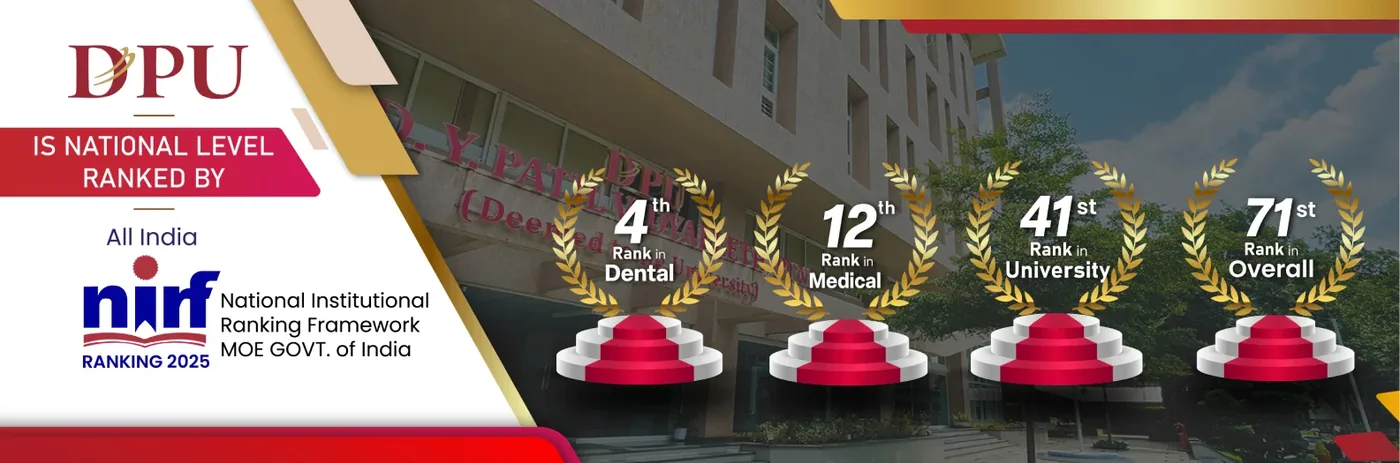
In the NIRF 2025 rankings (Ministry of Education), the parent Dr. D. Y. Patil Vidyapeeth placed #41 in the University category, #71 Overall, #12 in Medical and #4 in Dental. Physiotherapy is not separately ranked by NIRF, but these results reflect the strength of the institutional ecosystem — teaching hospital, research and faculty — that the College of Physiotherapy is part of.
Need Help With DPU College of Physiotherapy BPT Admission? Free Counselling
Get personalised help with the BPT admission route, eligibility, fee planning and a realistic college shortlist for physiotherapy. No agent fees.
WhatsApp for Guidance Call +91 91126 50438Fees, scholarships & funding the BPT/MPT programme at Dr. D. Y. Patil
Official fee tiers for Dr. D. Y. Patil are listed in the fee table above. As a deemed-university programme, BPT here has no government/CAP-quota fee tier — the General-category seat (85% of the 100-seat intake) at the published fee is the standard route, with a separate NRI/PIO/FN/Institutional tier. Plan funding early: education loans are available from SBI (Scholar Loan), HDFC Credila, Axis and most banks via the Vidya Lakshmi portal, often covering tuition plus hostel. Ask the university's scholarship/fee office about any merit- or means-based concession, instalment facility or central-sector scholarship eligibility for the 2026 intake. Budget separately for hostel, mess and one-time charges in Pune, which are billed over and above the tuition shown above.
The bpt/mpt programme admission 2026 at Dr. D. Y. Patil: step by step
- Meet the eligibility (10+2 with Physics, Chemistry, Biology and English).
- Register on the official DPU admissions portal, choose the BPT programme and pay the processing and entrance-test fee before the last date.
- Appear for DPU's own Online Proctor-Based entrance exam (DPU-CET / AIAHET) — the DY Patil physiotherapy entrance exam for this cycle was held on 28 June 2026.
- Check the DPU merit list, attend the counselling/admission session at Pimpri and confirm your seat within the deadline.
- Carry originals: 10th/12th marksheets, ID, category & domicile certificates and the fee payment.
Admission is through DPU's own entrance exam and merit list — not NEET, not the state CAP/MHT-CET process and not any state counselling body such as KEA. Watch the official portal for the counselling schedule so you do not miss a reporting deadline.
Why choose Dr. D. Y. Patil, Pune?
Dr. D. Y. Patil gives students hands-on clinical/practical exposure through its attached teaching facilities and a structured internship, which is what employers and PG-entrance examiners value most. Studying in Pune adds the advantage of an established healthcare-education ecosystem, peer hospitals for postings, coaching for licensure/PG entrances, and good transport connectivity for students from across Maharashtra and other states. When you shortlist Dr. D. Y. Patil, weigh the fee tier you qualify for, the campus and hospital infrastructure, faculty strength and the internship stipend — not just the brand name.
After the BPT/MPT programme: internship, registration & higher studies
The programme includes a compulsory rotating internship, after which graduates register with the state physiotherapy council / IAP to practise. From there the common paths are MPT specialisations (musculoskeletal, neuro, sports, cardiopulmonary), or going straight into work — typical roles include hospitals, orthopaedic and sports-rehab centres, neuro and paediatric rehabilitation, geriatric care, corporate wellness and independent practice. Many Dr. D. Y. Patil graduates also prepare during internship for PG-entrance exams or overseas licensure, so it pays to plan that timeline from the first year rather than the last.
- Data Sources: Fees, cutoffs, rankings, and placement data are sourced from official institutional records.
- Verification: Figures are subject to change; always verify details on the official university website before making admission or payment decisions.
- Platform Status: FindUrCollege is an independent platform. We are affiliated with many, but not all, listed institutions.
Related MBBS Colleges in Pune
- DY Patil Ambi MBBS 2026
- DY Patil Medical College Pune MBBS 2026
- SKNMC Pune MBBS Admission 2026
- MIMER Medical College Talegaon Pune MBBS 202
- NRI Quota Admission 2026
- Sancheti SICOP Pune BPT 2026
- SMCW Pune MBBS 2026
- AFMC Pune MBBS 2026
- Bharati Vidyapeeth Engineering Pune 2026
- BJ Pune MBBS 2026
- Top Engineering Colleges in Pune 2026
- BVMC Pune MBBS 2026
- Deemed Medical College Fees 2026
- DY Patil Pune Direct Admission 2026
Related 2026 Admission Guides
More 2026 guides from FindUrCollege: