
Best private engineering colleges for placements: ten source-backed comparisons
The table below compares four-year undergraduate programme outcomes for 2024–25, as reported in the named institutions’ NIRF 2026 submissions. Thapar’s source is its Overall submission; the other linked filings are Engineering submissions. The population is the reporting institution’s UG four-year group, not automatically CSE or one campus.
| Reporting institution | Graduating year | Graduated in minimum time | Students placed | Median annual salary | Higher studies |
|---|---|---|---|---|---|
| IIIT Hyderabad | 2024–25 | 150 | 148 | ₹34.40 lakh | 2 |
| PES University | 2024–25 | 1526 | 1068 | ₹13.05 lakh | 258 |
| BMS College of Engineering | 2024–25 | 1291 | 972 | ₹10.00 lakh | 79 |
| Thapar Institute of Engineering and Technology | 2024–25 | 2205 | 1900 | ₹10.00 lakh | 140 |
| Vishwakarma Institute of Technology, Pune | 2024–25 | 1532 | 1442 | ₹8.10 lakh | 46 |
| Ramaiah Institute of Technology | 2024–25 | 1177 | 908 | ₹7.00 lakh | 195 |
| Nitte Meenakshi Institute of Technology | 2024–25 | 1000 | 831 | ₹6.57 lakh | 37 |
| SRM Institute of Science and Technology | 2024–25 | 4408 | 4144 | ₹6.32 lakh | 142 |
| Vellore Institute of Technology | 2024–25 | 11913 | 7023 | ₹6.00 lakh | 1660 |
| Pimpri Chinchwad College of Engineering | 2024–25 | 1042 | 653 | ₹4.50 lakh | 37 |
Original sources (UG four-year rows on physical page 1 of each linked submission):
- IIIT Hyderabad: NIRF 2026 submission
- PES University: NIRF 2026 submission
- Thapar Institute of Engineering and Technology: NIRF 2026 submission
- Vishwakarma Institute of Technology, Pune: NIRF 2026 submission
- Ramaiah Institute of Technology: NIRF 2026 submission
- SRM Institute of Science and Technology: NIRF 2026 submission
- Vellore Institute of Technology: NIRF 2026 submission
- Pimpri Chinchwad College of Engineering: NIRF 2026 submission
This BTech and BE comparison includes colleges and private engineering universities with different programme mixes. Use the evidence shown for your shortlist; it is not an exhaustive national league table. Institutions with different programme mixes and cohort sizes need additional context. A median is the middle salary of the reported placed graduates, not the salary of every graduate.
Highest package, average package and median: what each answers
Highest package answers how large the single highest reported offer was. It can be useful as an example of opportunity, but it does not describe a typical student. Check whether the figure is domestic or international, on-campus or off-campus, and cash salary or total CTC.
Average package is the arithmetic mean of the offers or placed-student salaries included by the institution. Large offers can move it upward. The population must be specified before comparing two averages.
Median package is the middle value in the reported salary set. It gives a different view of typical pay, but still concerns the placed group. It does not tell you how many students sought jobs and did not obtain one.
Students placed and job offers are different counts. One student can receive multiple offers. A brochure with an offer count therefore cannot establish a unique-student placement rate without additional information.
Historical placement trends: retain the older cohorts
The same submissions provide earlier UG four-year medians. These help you see whether the newest figure follows a stable pattern or a change.
| Institution | 2022–23 median | 2023–24 median | 2024–25 median |
|---|---|---|---|
| IIIT Hyderabad | ₹30.30 lakh | ₹32.00 lakh | ₹34.40 lakh |
| PES University | ₹12.00 lakh | ₹12.80 lakh | ₹13.05 lakh |
| BMSCE | ₹9.00 lakh | ₹8.50 lakh | ₹10.00 lakh |
| NMIT | ₹5.80 lakh | ₹5.22 lakh | ₹6.57 lakh |
| PCCOE | ₹5.75 lakh | ₹4.80 lakh | ₹4.50 lakh |
| VIT Pune | ₹7.00 lakh | ₹7.50 lakh | ₹8.10 lakh |
| Ramaiah Institute of Technology | ₹8.00 lakh | ₹7.50 lakh | ₹7.00 lakh |
| Vellore Institute of Technology | ₹9.00 lakh | ₹8.99 lakh | ₹6.00 lakh |
| SRM Institute of Science and Technology | ₹6.10 lakh | ₹6.20 lakh | ₹6.32 lakh |
Sources: the corresponding original NIRF submissions linked above. Do not rename the graduating year as the reporting year: a 2026 submission can contain 2024–25 placement outcomes. Historical data remains useful, but it should remain visibly historical.
Average and highest packages: dated campus examples
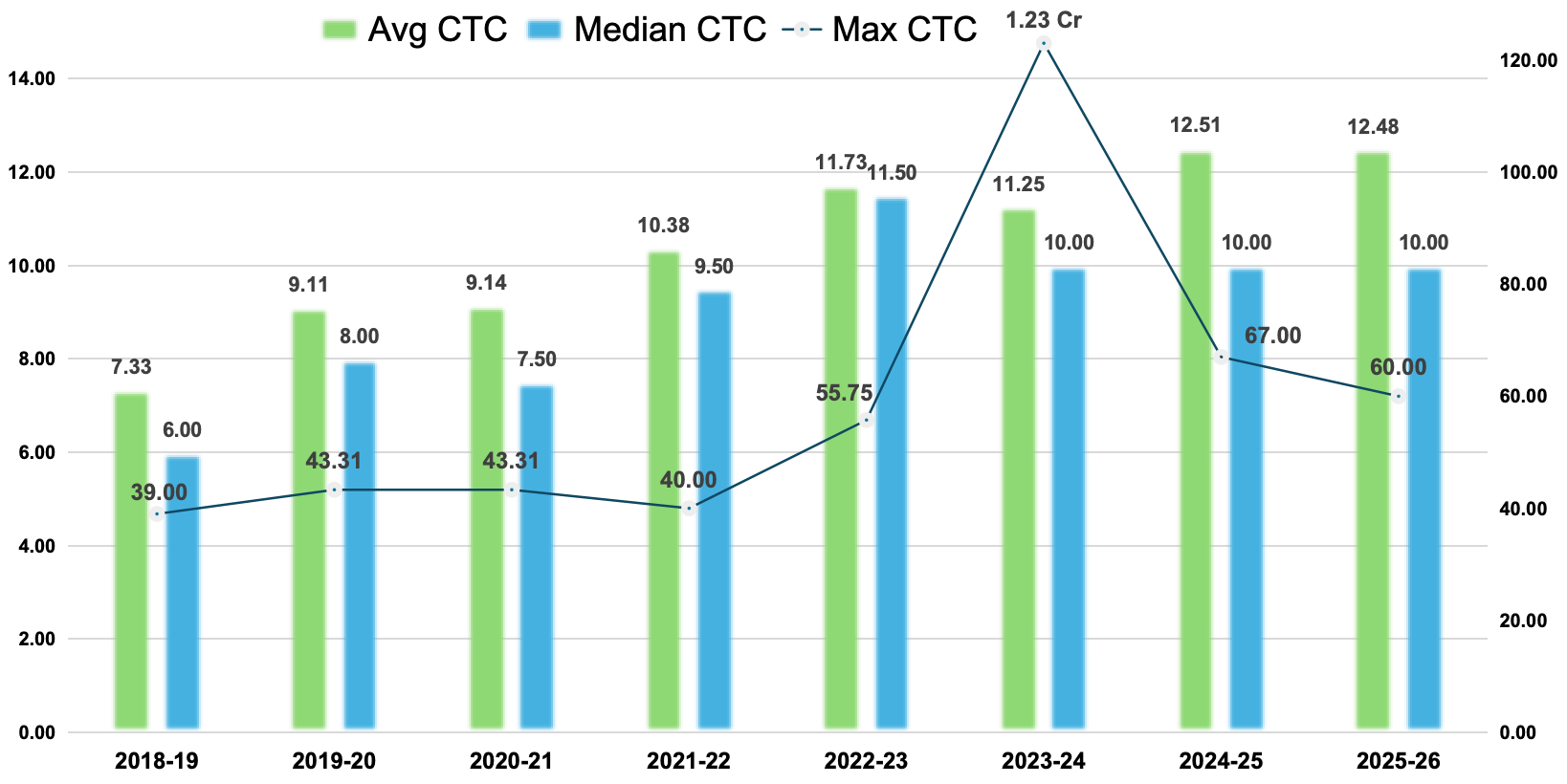
These examples answer a different question from the NIRF median comparison. They are campus reports with the scope and year printed beside each figure; they do not form an all-India ranking by average CTC.
| Institution and source | Reported cohort | Average CTC | Highest CTC | Scope |
|---|---|---|---|---|
| TIET campus CTC chart | 2025–26 | ₹12.48 LPA | ₹60 LPA | Campus figures; the same chart gives a ₹10 LPA median |
| TIET campus CTC chart | 2024–25 | ₹12.51 LPA | ₹67 LPA | Campus figures; the same chart gives a ₹10 LPA median |
| PICT 2026–27 prospectus | 2024–25 | ₹10.37 LPA | ₹46.38 LPA | Overall result printed in the prospectus; not a CSE-only average |
Sources: TIET's official CTC chart and PICT's 2026–27 prospectus, printed page 14, available through the official PICT admission documents. A large offer in one year does not establish the starting salary of the next intake.
CSE placements versus overall engineering placements
Students choosing CSE, IT, AI/Data Science or Electronics need branch evidence where available. The institution-level table above cannot be relabelled as “CSE median”. A university-wide figure also cannot be assigned to one campus without a campus-specific source.
For a campus placement report, look for the programme, graduating batch, registered or eligible student count, number placed and the salary definition. If the report only gives an overall result, keep that label while comparing the curriculum and admission cost of the branch you want.
This matters especially for broad university reports. Vellore Institute of Technology’s NIRF reporting scope is not established as one CSE branch at Vellore merely by the institution’s name. The same care applies to SRM’s reported UG group.
Branch-wise placement example: PICT Computer Engineering, IT and E&TC
PICT's separately archived Training and Placement Report 2024–25 gives the following branch averages. Its summary has an overall average of ₹10.11 LPA and median of ₹7.14 LPA. Keep that report separate from the later prospectus's ₹10.37 LPA overall average.
| Programme in the archived report | Department average | Students placed in the report |
|---|---|---|
| BE Computer Engineering | ₹10.84 LPA | 252 |
| BE Information Technology | ₹10.59 LPA | 167 |
| BE Electronics and Telecommunication | ₹8.31 LPA | 148 |
Source: PICT Training and Placement Report 2024–25, archived original, summary on physical page 3. These are historical report figures, not a 2026 CSE forecast. Use the PICT Pune profile for its programme names, admission categories and cutoff history.
PICT, RVCE, BMSCE, BITS and Manipal in a placement shortlist
Use the PICT Pune profile to connect its branch-level evidence below with the exact admission category and historical cutoff.
For RV College of Engineering and BMS College of Engineering, combine the exact branch admission cutoff with the college’s own dated placement evidence. COMEDK and KCET fees can lead to different costs for the same institution.
For BITS Pilani and Manipal Institute of Technology, identify the exact campus and programme before comparing a salary headline. A group-wide result and a campus-specific result answer different questions. Keep BITSAT or MET/university admission requirements separate from a placement comparison; a high package does not imply that management admission exists.
The individual Thapar, PES University, MSRIT, VIT Pune and SRM Chennai guides can help connect course and admission choices with the source evidence.
Placement percentage: choose the right denominator
The NIRF table reports graduates in minimum stipulated time, placed students and students entering higher studies. It does not necessarily report all eligible-and-interested job-seekers. Dividing placed students by graduates would describe that ratio, not automatically the institution’s placement rate among registrants.
For example, MSRIT reports 908 placed and 1,177 graduates for 2024–25, alongside 195 higher-study selections. Those numbers should be presented as the source reports them. Do not assume every remaining graduate sought a job, or subtract higher studies without knowing whether the categories overlap.
Similarly, PCCOE’s 2024–25 NIRF filing records 1,042 graduates and 653 placed. A differently scoped campus report can use a different denominator. Match the report before comparing percentages.
Fees and return on investment: build your own budget
A useful cost comparison separates academic fees, accommodation, mess, deposits, travel and loan interest. Use the admission route you can actually obtain, not the lowest fee paid by any student at the college.
As one example, MSRIT’s 2026–27 first-year B.E. circular lists ₹1,40,820 for Karnataka under CET and ₹3,54,820 for Karnataka under COMEDK/Management. The institution is the same, but the academic payment differs by route. The corresponding non-Karnataka/SAARC figures are ₹1,42,620 and ₹3,56,620. These are the first-year amounts in that circular, not four-year totals or a complete quotation for every admission category.
Source: MSRIT first-year fee circular, 2026–27.
Thapar’s 2026–27 fee document lists ₹26 lakh as the eight-semester academic programme amount for its highest fee group, which includes the named computing programmes, with a separate admission charge and living costs. That programme total and an annual fee at another college must not be placed in one column without labelling the period.
Source: TIET 2026–27 fee document.
Avoid a “six-month payback” calculation based on CTC. CTC is not monthly take-home pay, and a placed-group median is not a guaranteed salary. Instead, test whether the family can afford the course under a conservative outcome, including a longer job search or further study if those are realistic possibilities.
Management and NRI admission: connect cost with the actual route
Some institutions publish management, institutional or NRI categories, while others use their own examination or merit process. Verify the category and written fee terms for each college separately. A management quotation cannot be inferred from a placement headline or a general fee table.
Read the management quota engineering fee guide for the questions to ask about programme cost, official receipts and admission conditions. Use the institution’s own documents to establish the answer.
Recruiters, internships and placement preparation
A recruiter logo answers less than a dated company-wise report. Check the role, eligible branches, academic criteria and actual selection count for the cohort you are comparing. A company may recruit for several roles with different salary structures.
For example, PICT's archived 2024–25 company-wise report records Mastercard, Barclays, PhonePe, HSBC and Infosys, with eligibility and selection columns. It reports 19 selections in the Mastercard row, 3 for PhonePe, 39 for HSBC and 8 for Infosys; the Barclays entries cover different rounds. These entries show recorded selections in that report, not a promise that each company will recruit every future batch. Source: the archived PICT report linked above, physical page 1.
When comparing placement support, ask for internship eligibility, whether pre-placement offers are counted separately, the academic/backlog rules and the time available for projects. For your own preparation, a useful plan is to build demonstrable course projects, practise the assessments required for your intended roles and explain your work clearly in interviews. Coding roles, electronics design, mechanical engineering and civil engineering need different preparation; an overall salary table cannot choose your specialisation for you.
Twenty college options to compare by region
Use this directory to move from a placement headline to the exact institution, branch, admission route and cost. The order is geographic, not a Top 20 placement ranking. Only figures with original sources appear in the comparison tables above.
| Region | Profiles and original records | What to compare next |
|---|---|---|
| Hyderabad | IIIT Hyderabad original submission; BITS Pilani campus guide | Exact programme and campus; qualifying route and the population behind the placement report |
| Bangalore | RVCE; BMSCE; MSRIT; PES University; NMIT | Institution and branch, applicable admission category and the fee payable through that route |
| Pune and Mumbai | PICT; VIT Pune; PCCOE; DYPCOE Akurdi; SIT Pune; KJ Somaiya School of Engineering | CAP colleges and university admission routes separately; current fees with historical branch cutoffs |
| North India | Thapar; JIIT Noida; Bennett University; LPU | Campus, entry route, scholarship renewal and the complete academic/living budget |
| Other southern options | VIT Vellore; SRM Chennai; MIT Manipal | Campus-specific admissions and fees; institution-level versus branch-level placement evidence |
Is it a good college for your goals? Tier 1, Tier 2 and Tier 3 labels
Treat a tier label as the author's shorthand until its method is stated. For your decision, compare the documented course, placement cohort, cost and attainable offer. A college can suit one branch, budget or career goal better than another without a universal tier deciding the answer.
PICT or VIT, and Thapar or VIT Vellore?
First specify which VIT: Vishwakarma Institute in Pune and Vellore Institute are different institutions. PICT's campus average is not directly comparable to VIT Pune's NIRF median. For Thapar and Vellore Institute, the UG four-year 2024–25 medians shown above are ₹10 lakh and ₹6 lakh respectively, but the cohort sizes and programmes differ. Add your actual branch offer and total cost before deciding.
A cost-and-placement worksheet for your shortlist
| Decision | What to record for each college |
|---|---|
| Programme | Exact degree, branch, campus and intake year |
| Admission | Accepted examination, category, selection procedure and historical cutoff where relevant |
| Cost | Year-by-year academic charges, hostel, mess, refundable deposits and scholarship renewal terms |
| Outcomes | Graduating batch, students placed, median/average, highest offer and the source's scope |
| Career fit | Curriculum, laboratories, projects, internships and eligibility for the roles you want |
| Budget resilience | What the family can pay if a scholarship is not renewed or employment starts later than hoped |
A lower annual fee does not automatically make one college the best ROI, and a high CTC does not settle an education-loan repayment plan. Compare the complete programme cost with the cash income and expenses relevant to your own plan. Keep institution fees, refundable deposits and optional services separate.
Placement-informed admission support
FindUrCollege can help compare documented placement evidence with your branch preferences and eligible management, institutional or NRI admission options. Discuss your engineering shortlist and budget. A past placement record is evidence for comparison, not a promised job or salary.
Frequently Asked Questions
Among the ten reported UG four-year 2024–25 rows shown here, IIIT Hyderabad has the highest median at ₹34.40 lakh. This is not a claim that the table exhausts every private institution in India.
Only if the source explicitly reports CSE. The NIRF rows here are the reporting institution’s UG four-year population, so they should not be renamed CSE-only medians.
A single maximum offer does not show the typical salary, number placed or total cost. Read it alongside a median/average, cohort scope and student counts.
Not necessarily. The newest graduating-year rows used in this comparison are 2024–25, reported in the 2026 submissions. Both years should remain visible.
No. Vishwakarma Institute of Technology in Pune and Vellore Institute of Technology are separate institutions with different admission and reporting records.
You can calculate a ratio to graduates, but that is not automatically the placement rate among eligible job-seekers. The denominator must be named and the source population understood.
Compare the full written cost with the actual admission route and a range of possible outcomes. A highest offer or median does not guarantee your future salary.
No. Keep verified older cohorts with their years and scope. They provide context for the newest result and help avoid treating one unusually strong year as permanent.
No. They should not be included as private management-quota institutions. Their public-institution admission routes belong in the relevant regional guides.
A nationwide average-package winner requires a complete set of comparable branch, cohort and salary definitions. This guide instead gives ten original UG four-year median rows and separately labelled campus averages. Among those median rows, IIIT Hyderabad reports ₹34.40 lakh for 2024–25; that figure is a median, not an average.
The 2024–25 UG four-year medians in the cited submissions are ₹6 lakh for Vellore Institute and ₹10 lakh for TIET. They cover different student populations. Compare the branch you can obtain, programme cost and campus-specific evidence alongside those institution-level figures.
Use a CSE or Computer Engineering report for a branch-level decision. The PICT example here gives an archived Computer Engineering average of ₹10.84 LPA for 2024–25. It cannot be ranked directly against an overall NIRF median. Compare like-for-like branch figures, course content and admission cost.
No. Read the reported denominator: all graduates, eligible students, registered job-seekers and participating students are different groups. Offer totals may include several offers for one person. A past report does not guarantee employment for a new entrant.
Look for the exact branch's eligible and placed counts, job roles, salary measure and graduating year. An institution-wide engineering result does not establish a Mechanical or Civil outcome, and a CSE recruiter list does not establish recruitment for every branch.
Use the applicable category fee, living costs and actual branch offer. Lower academic charges can reduce the budget, but one historical salary or highest package does not establish a universal return on investment. Keep CAP and institutional fee categories separate.
Open its dated placement report and original NIRF submission. Match the programme, campus, graduating year, student count and salary definition, then compare any brochure claim with that scope. Read a recruiter list as employer history unless a particular year's selection data is given.
Admission category does not promise a job or salary. Establish the institution's published admission route and fee terms first, then check the course's placement eligibility and historical results separately. FindUrCollege can help compare documents and eligible options; the institution decides admission.
Data Accuracy Notice
- Data Sources: The cited institutional NIRF submissions, placement documents and fee circulars, with original source links beside the relevant tables and explanations.
- Verification: Read each figure with its year, programme, campus and admission category. Spotted an error? Send the page and section to support@findurcollege.com. We re-check against the official document and correct the page within 48 hours. Read our editorial policy.
- Platform Status: FindUrCollege is an independent platform. We are affiliated with many, but not all, listed institutions.