
Thapar Institute of Engineering and Technology (TIET): which programme are you choosing?
Thapar Institute of Engineering and Technology (TIET), commonly called Thapar University, publishes its BE/B.Tech admission rules through the official admissions portal. The following is its 2026–27 programme list. These are published intake figures, not seats currently available. TIET is a deemed-to-be university in Patiala, Punjab. Its NIRF 2025 Engineering rank was 29, with a score of 60.97. This institution-level ranking is separate from a branch's admission cutoff or placement result. Source: NIRF 2025 Engineering ranking, institute ID IR-E-I-1480.
| Programme | Admission code | 2026–27 seats |
|---|---|---|
| Computer Engineering | COE | 960 |
| Computer Science & Engineering, Patiala | COPC | 540 |
| Computer Science and Business Systems | COBS | 60 |
| Artificial Intelligence and Data Science | DSAI | 240 |
| Electrical and Computer Engineering | EEC | 120 |
| Electronics & Communication Engineering | ECE | 240 |
| Electronics and Computer Engineering | ENC | 360 |
| Robotics and Artificial Intelligence | RAI | 120 |
| Electronics Engineering: VLSI Design and Technology | EVD | 90 |
| Electronics: Instrumentation & Control | EIC | 90 |
| Mechanical Engineering | MEE | 120 |
| Mechatronics | MEC | 60 |
| Chemical Engineering | CHE | 60 |
| Civil Engineering | CIE | 90 |
| Civil Engineering with Computer Applications | CCA | 30 |
| Electrical Engineering | ELE | 90 |
| Biomedical Engineering | BME | 30 |
| Biotechnology | BT | 90 |
The total is 3,390 seats. The prospectus says this table includes International Engineering Programme seats. A programme's total intake is therefore not an additional pool of international seats to add again. Robotics and Artificial Intelligence is offered jointly by the Mechanical Engineering and Computer Science & Engineering departments.
Source: TIET first-year BE/B.Tech prospectus, 2026–27, physical page 1.
Thapar University admission: JEE Main, board marks and direct applications
For the 2026 intake, the nine programmes from COE through EVD in the table above used JEE Main All India Rank for admission. The prospectus separately allowed JEE Main or qualifying-examination merit for EIC, Mechanical, Mechatronics, Chemical, Civil, Civil with Computer Applications and Electrical Engineering. Biomedical Engineering and Biotechnology had additional NEET and PCB-based options.
This distinction answers a common question about Thapar direct admission: a route listed for Civil or Mechanical Engineering does not establish a board-only route into CSE. The prospectus also describes institute-offered direct admission to specified non-computing programmes, subject to eligibility and seat availability. Candidates without JEE Main in those specified routes are subject to the institute's stated entrance-test condition.
For the general eligibility route, the prospectus also required passing Class 12 in 2024 or 2025, or appearing in 2026. The general 2026 BE/B.Tech subject-marks requirement was at least 60% in Physics, Mathematics and one permitted third subject, reduced to 55% for SC/ST candidates. The permitted third subjects were Chemistry, Biology, Biotechnology or a Technical Vocational subject. The prospectus sets out the route-specific exceptions for the biological programmes. Read the programme's full conditions before applying through a different subject combination.
For the next intake, use the relevant year's prospectus and submit the institute application. A JEE result by itself is not a TIET application. Enter the programme preferences in the order you would actually accept them; an unfamiliar course code can otherwise produce an unwanted choice.
Source: TIET admission and eligibility criteria, physical pages 1–3.
Punjab quota and Outside Punjab quota
The 2026 rules reserved 50% of the seats for Punjab candidates and 50% for candidates from outside Punjab. The qualifying school's location matters. The prospectus also provides a Punjab-residency-certificate route for applicants who completed Class 12 outside Punjab, with the prescribed residency certificate, Annexure XV certificate and an affidavit that no other State/UT quota has been used. Do not decide your category from a postal address alone.
GENP means General Punjab; GENO means General Outside Punjab. Use the correct column in the historical cutoffs below.
Source: TIET distribution of seats and category documentation.
Thapar University B.Tech fees 2026–27: semester, annual and total costs
TIET's fee document publishes both a semester instalment and a total programme fee for the 2026–27 entry batch. These amounts exclude accommodation and the separate one-time admission charge.
| Programme group | Per semester | Published eight-semester programme fee |
|---|---|---|
| DSAI, COE, CSE, CSBS and ENC | ₹3,25,000 | ₹26,00,000 |
| Biotechnology, ECE, EEC, EVD and RAI | ₹2,94,800 | ₹23,58,400 |
| Other BE/B.Tech branches in the schedule | ₹2,48,600 | ₹19,88,800 |
For two semesters, the academic charges calculate to ₹6,50,000, ₹5,89,600 and ₹4,97,200 respectively. These calculated annual amounts include development and other charges; they are not tuition alone. The one-time admission fee is ₹30,000. For the highest fee group, the semester instalment comprises ₹2,57,000 tuition, ₹57,000 development fee and ₹11,000 other charges. For the middle group the corresponding amounts are ₹2,26,800, ₹57,000 and ₹11,000; for the other-branches group, ₹1,82,600, ₹55,000 and ₹11,000.
The document explicitly limits this schedule to the 2026–27 entry batch and reserves the institute's right to revise charges. It is not a quoted price for a student joining in 2027. For a regular Indian-category International Engineering Programme student, the document specifies the first two years at 1.5 times the normal TIET rate, followed by the foreign university's fee for the remaining two years. FN/NRI IEP students have their own conditions. Budget the Indian and overseas portions separately.
For a detailed cost worksheet, use Thapar tuition and programme fees. Keep the refundable amounts, accommodation, mess, travel and personal expenses separate from the academic fee.
Source: TIET fee and other dues, 2026–27, physical pages 1–2.
Thapar University cutoff 2026: JEE Main Round 1 and Round 2
These are historical JEE Main AIR results, not predicted 2027 cutoffs. Lower rank numbers represent stronger ranks. Different rounds need not move in the same direction.
Round 1: 16 May 2026
| Programme code | GENO closing AIR | GENP closing AIR |
|---|---|---|
| COPC | 53883 | 98314 |
| COE | 106367 | 224974 |
| COBS | 90505 | 214284 |
| DSAI | 79882 | 208550 |
| ENC | 137419 | 408970 |
| ECE | 147713 | 496210 |
| EEC | 158295 | 550898 |
| RAI | 129983 | 332592 |
The published Round 1 EVD entry is GENO AIR 1,71,351. The table above includes programmes with both General category entries in that round.
Source: TIET first online counselling cutoff, 16 May 2026, physical page 1.
Round 2: 29 June 2026
| Programme code | GENO closing AIR | GENP closing AIR |
|---|---|---|
| COPC | 39265 | 59508 |
| COE | 47525 | 200177 |
| COBS | 49808 | 93043 |
| DSAI | 46427 | 68143 |
| ENC | 39069 | 68302 |
| ECE | 41564 | 114210 |
| EEC | 55744 | 251236 |
| RAI | 52279 | 213078 |
| EVD | 49466 | 296123 |
COPC's Round 2 Outside Punjab cutoff was AIR 39,265, corresponding to 97.5254333 percentile in that document. The Punjab entry was AIR 59,508, at 96.223574 percentile. Those are distinct results; neither is a universal Thapar CSE cutoff.
For the same Round 2 COPC result, the notice also prints SCO AIR 3,22,915, STO AIR 5,72,949, PHO AIR 2,80,966 and BC Punjab AIR 1,58,845. Those categories have their own eligibility requirements; they are not alternatives an applicant can freely select.
Source: TIET second online counselling cutoff, 29 June 2026, physical pages 1–2.
Thapar cutoff 2025: historical branch-wise results
The 9 June 2025 second online round published these General Outside Punjab (GENO) JEE Main AIR results. The original programme codes are retained, including the historical COSE Derabassi entry; they should not be assumed to be the following year’s offered programme list.
| 2025 programme code | GENO closing AIR |
|---|---|
| COPC | 33,379 |
| COE | 60,977 |
| COBS | 58,400 |
| COSE | 67,978 |
| DSAI | 54,769 |
| ENC | 69,177 |
| ECE | 47,689 |
| EEC | 73,624 |
| RAI | 64,238 |
| EVD | 77,189 |
In TIET's 9 June 2025 second online round, COPC closed at AIR 33,379 for GENO and 31,743 for GENP. Preserve this result as a 2025 reference. It does not mean every subsequent round or future intake must close at a weaker rank.
Source: TIET second online counselling cutoff, 9 June 2025.
The Thapar cutoff guide is the companion page for programme and category comparisons. In your own shortlist, record year, round, programme code and category together with the rank.
Thapar JEE Main closing percentiles: 2025 Round 2 and 2026 Rounds 1–2
These exact percentiles are for General Outside Punjab (GENO) in the three named notices. They are not predicted admission scores. Read the programme code and year together.
| Programme | 2025 Round 2 | 2026 Round 1 | 2026 Round 2 |
|---|---|---|---|
| COPC: Computer Science, Patiala | 97.8210473 | 96.5822547 | 97.5254333 |
| ENC: Electronics and Computer | 95.4093554 | 91.1530550 | 97.5341756 |
| ECE: Electronics and Communication | 96.8661150 | 90.4944802 | 97.3719417 |
| DSAI: AI and Data Science | 96.3833563 | 94.9117875 | 97.0635805 |
| COE: Computer Engineering | 95.9720585 | 93.1559200 | 96.9889016 |
| EVD: Electronics, VLSI | 94.8789148 | 88.9731758 | 96.8636797 |
| COBS: CS and Business Systems | 96.1428288 | 94.2113780 | 96.8356232 |
| RAI: Robotics and AI | 95.7577978 | 91.6384836 | 96.6858727 |
| EEC: Electrical and Computer | 95.1040704 | 89.7964147 | 96.4546247 |
The historical COSE Derabassi row in 2025 Round 2 closed at 95.5064507 percentile / AIR 67,978. Keep that result under its own year and campus; the programme list above describes the 2026–27 prospectus.
Sources: 2025 Round 2, 2026 Round 1 and 2026 Round 2.
For COPC GENO, the Round 2 AIR changed from 33,379 in 2025 to 39,265 in 2026. Within 2026 it moved from 53,883 in Round 1 to 39,265 in Round 2. The examples show why “later round” does not automatically mean an easier cutoff, and why a previous closing score cannot guarantee a future seat.
Thapar placements: average package, median and highest salary history
TIET publishes a year-on-year CTC chart on its placement page. The table below preserves its historical salary figures. These are the institute's published campus-placement measures; they are not a CSE-only average or a guarantee of an individual offer.
| Placement year in TIET chart | Median, LPA | Average, LPA | Highest, LPA |
|---|---|---|---|
| 2018–19 | 6.00 | 7.33 | 39.00 |
| 2019–20 | 8.00 | 9.11 | 43.31 |
| 2020–21 | 7.50 | 9.14 | 43.31 |
| 2021–22 | 9.50 | 10.38 | 40.00 |
| 2022–23 | 11.50 | 11.73 | 55.75 |
| 2023–24 | 10.00 | 11.25 | 123.00 |
| 2024–25 | 10.00 | 12.51 | 67.00 |
| 2025–26 | 10.00 | 12.48 | 60.00 |
Source: TIET year-on-year CTC chart, linked from the official placement page, read 2 November 2026. The chart prints ₹1.23 crore for 2023–24; the table expresses the same amount as ₹123 lakh to keep one unit.
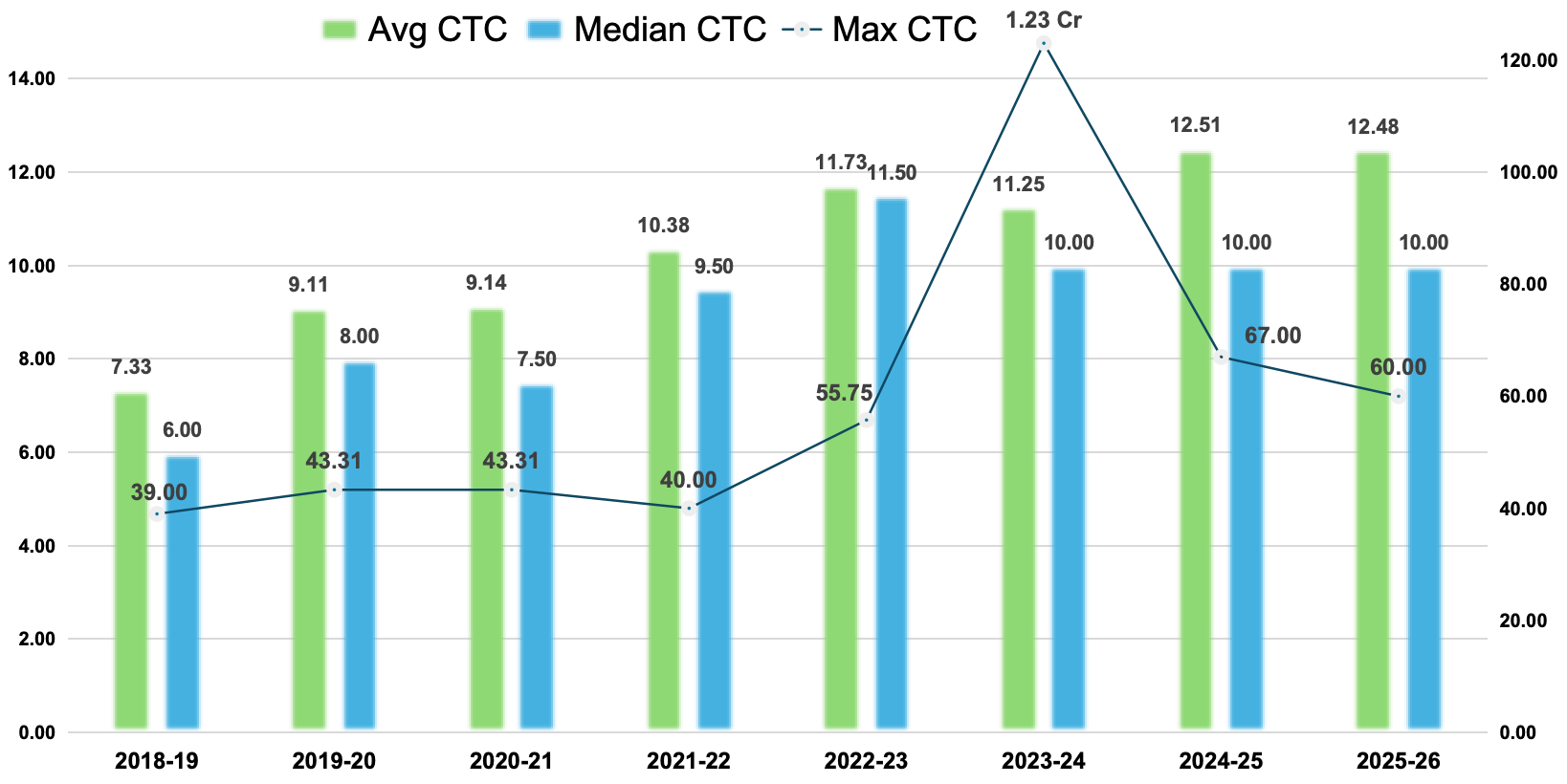
The chart's median stays at ₹10 lakh from 2023–24 through 2025–26, while its average changes. The ₹1.23 crore highest figure belongs to 2023–24; the 2025–26 maximum is ₹60 lakh. These measures answer different questions: the highest is an extreme outcome, the average is the arithmetic mean, and the median is the middle value.
Top-average CTC and the placement highlights snapshot
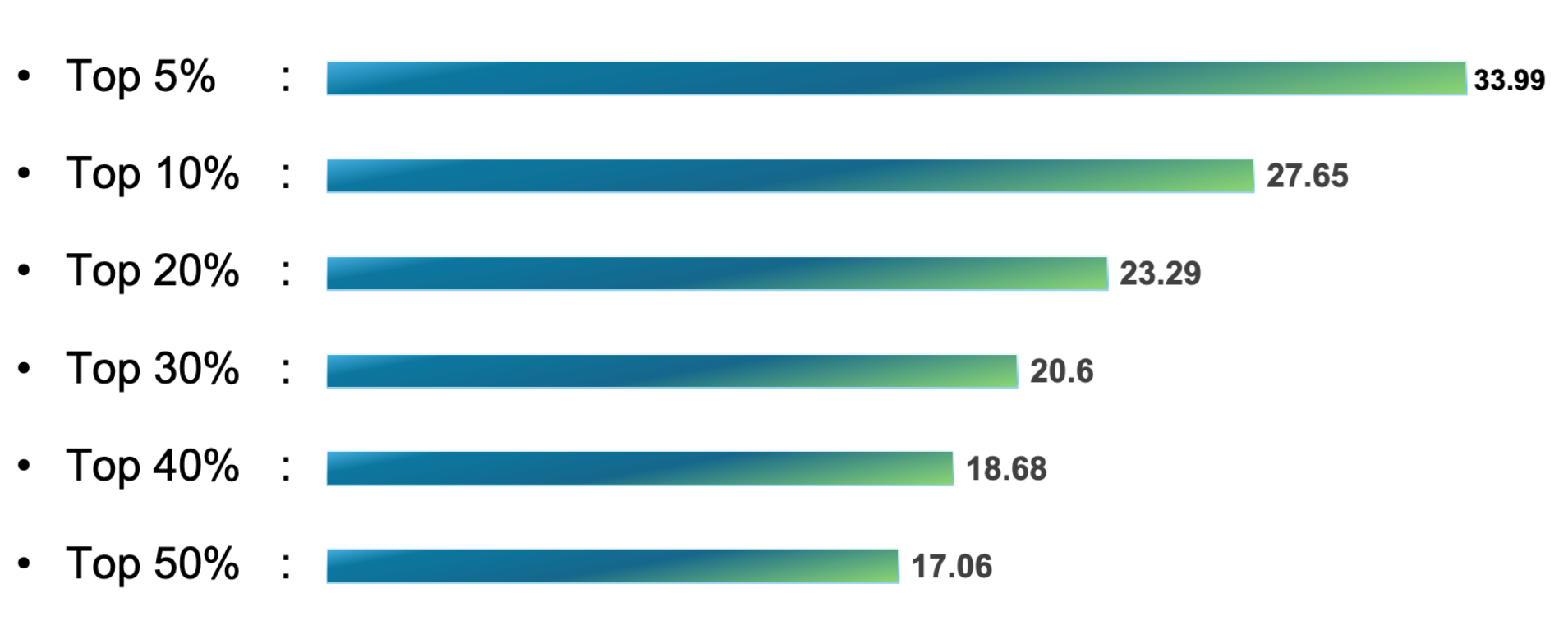
TIET's separate top-average chart reports ₹33.99 LPA for the top 5%, ₹27.65 LPA for the top 10%, ₹23.29 LPA for the top 20%, ₹20.60 LPA for the top 30%, ₹18.68 LPA for the top 40% and ₹17.06 LPA for the top 50%. Treat this as the separately published chart captured on 2 November 2026; it does not establish the salary of the other half of a particular graduating batch.
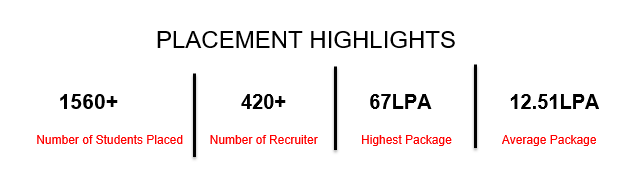
The placement-highlights panel captured on the same date reports 1,560+ students placed, 420+ recruiters, ₹67 LPA highest and ₹12.51 LPA average. Keep that panel as a separate snapshot from the year-labelled chart and NIRF cohort counts below.
Sources: TIET top-average CTC chart and placement highlights panel.
NIRF four-year undergraduate placement counts
TIET's NIRF 2026 Overall submission reports the following for four-year undergraduate programmes. A median is the middle salary among placed graduates; it is not a salary promise for each student or a CSE-only result.
| Graduating academic year | Graduated in minimum time | Students placed | Median annual salary | Higher studies |
|---|---|---|---|---|
| 2022–23 | 2259 | 1962 | ₹11.89 lakh | 193 |
| 2024–25 | 2205 | 1900 | ₹10.00 lakh | 140 |
For 2023–24, the same submission records 2,082 graduates, 1,708 placed and 152 entering higher studies. These counts help you judge the cohort alongside a salary headline. They should not be converted into a placement rate among job-seekers because the report uses graduates in minimum stipulated time as its count, not a separately defined eligible-and-interested placement pool.
Compare Thapar's programme curriculum, internships and cost with the role you want after graduation. Use Thapar placement reports for the supporting placement discussion and private engineering placement comparisons for other institutions.
Source: TIET NIRF 2026 Overall submission, physical page 1.
Thapar scholarships: merit and branch-specific waivers
The 2026–27 scholarship policy uses JEE Main AIR together with qualifying marks, not a blanket discount for reaching a particular JEE percentile.
| Scholarship | First-year selection described in the policy | Benefit |
|---|---|---|
| Merit I | First 50 students by JEE Main AIR, irrespective of branch; Class 12 aggregate above 95% | Tuition and development fee waiver |
| Merit II | Next 60 students by JEE Main AIR; Class 12 aggregate above 90% | Tuition fee waiver |
| Merit III | First 10% of admitted students in each discipline by JEE Main AIR, subject to the policy; Class 12 aggregate above 85% | Half tuition fee waiver |
For these scholarships, the qualifying aggregate uses four subjects including English, with the subject substitutions specified in the policy; it is not simply an unspecified overall board percentage. Renewal depends on the policy's academic-performance, merit and no-backlog conditions. A first-year award is not automatically a four-year award at the same level.
There is also a separate tuition waiver for Biomedical, Chemical, Civil with Computer Applications, Civil, Electrical, Instrumentation & Control, Mechanical and Mechatronics. The fee document specifies 30% tuition waiver at PCM 80% or above, or 20% at PCM 75% to below 80%, continuing with AGPA of at least 8.5 at the end of each academic year. It does not extend this branch-specific concession to CSE.
Source: TIET scholarship policy, 2026–27, physical pages 1–3.
Source: TIET branch-specific tuition waiver, physical page 1.
Thapar NRI admission and international fees
The FN/NRI prospectus provides 15% supernumerary seats in each programme/discipline, with admission based on qualifying-examination merit. For BE/B.Tech, it specifies at least 60% in Physics, Mathematics and a permitted third subject. For the NRI category, the prospectus defines candidates by completion of the qualifying examination abroad and requires a passport. The FN/NRI categories have defined documentary requirements; an Indian applicant should not assume that a relative abroad alone establishes eligibility.
The 2026–27 FN/NRI fee document lists USD 10,000 annually for BE/B.Tech, a published four-year programme total of USD 40,000, and a separate one-time admission fee of USD 500. Compare the applicable category, scholarship and international-programme conditions in the actual offer before budgeting.
Source: TIET FN/NRI admission conditions, physical pages 1–2.
Source: TIET FN/NRI fees, physical page 2.
Hostel, campus facilities and student life in Patiala
TIET's official hostel page lists 17 on-campus hostels: 10 for boys and 7 for girls, with Wi-Fi and round-the-clock security. Accommodation is a separate part of the budget from programme fees. Match the hostel allotment, room type, mess charges and refundable deposits to the applicable fee notice before accepting a room.
For accommodation questions, the institute lists its hostel administration at ao_hostels@thapar.edu. Use the official hostel page and the Thapar hostel and mess guide alongside your allotment instructions. Keep Patiala engineering accommodation separate from management programmes at Dera Bassi.
The TIET student-life page links student societies, festivals, sports, the health centre, library and counselling services. It also identifies the Team Fateh and Team Oorja formula-racing activities and the MARS robotics chapter. These are useful starting points for comparing life beyond lectures: look at the activity you want to join and the department supporting it, rather than choosing from a generic campus description.
Research, laboratories and specialisations
TIET's research office describes work in artificial intelligence, biomedical engineering, emerging materials, smart manufacturing, food security and electric vehicles. For a research-focused shortlist, look at the relevant department's current projects, facilities and supervision opportunities.
The 2026–27 undergraduate prospectus also lists programme-specific elective baskets. Computer Engineering includes high-performance computing, computer animation and gaming, and information and cyber security. Computer Science & Engineering includes data science, mathematics and computing, financial derivatives, DevOps, conversational AI, edge AI and robotics, and full-stack development. These are elective options within the programme structure, not additional admission branches with invented cutoff rows.
For non-CSE students, the prospectus describes an optional Minor in CSE: six additional computer-based courses carrying 20 credits, with a completion certificate. It states ₹10,000 per course for courses outside the regular curriculum. Industry-supported elective baskets have a separately stated one-time charge of ₹20,000–₹50,000 before semester five. Include optional academic charges only when they apply to your chosen study plan.
Thapar versus NITs, VIT Vellore and MIT Manipal
Ranking and branch fit: is Thapar a good choice?
For a “Tier 1 or Tier 2” comparison, start with the specific ranking, branch and outcome being measured. TIET’s NIRF 2025 Engineering rank was 29; that rank does not assign a salary or admission chance to an individual student. A useful comparison pairs the course you can obtain with its curriculum, full cost and the dated placement evidence above. Source: NIRF 2025 Engineering ranking.
Compare the actual branch offers before comparing college names. Thapar's COE, COPC, COBS, DSAI and electronics programmes have different curricula, fees and closing ranks; a broad “CSE versus CSE” comparison can hide those differences.
| Decision | What to compare for each actual offer |
|---|---|
| Admission route | The institute's own application and category rules; use the appropriate official counselling route for the other institution |
| Academic choice | Programme code, curriculum, electives, internships and the flexibility you need |
| Full cost | Programme fee, admission charge, accommodation, mess and any optional international study |
| Scholarship | Confirmed award and renewal conditions, separately from a possible award |
| Placements | Same graduating year, course coverage and salary measure; count placed students alongside salaries |
| Location and daily life | Campus, travel, accommodation and the societies or facilities you would use |
For Thapar's CSE/COE fee group, the 2026–27 schedule publishes ₹26 lakh over eight semesters before the one-time admission fee and living costs. A salary package is annual CTC, not money received upfront or take-home pay. A claim that the degree “pays for itself in 12–18 months” cannot be calculated from those two headline numbers alone.
Use the VIT Vellore profile, MIT Manipal profile and Delhi NCR engineering guide to compare the alternatives you are considering. The best choice depends on the branch you can obtain and afford, not an unsupported universal college order.
How to apply to Thapar: documents, branch choices and admission support
Start at the official TIET admission portal and use the prospectus for your entry year. The 2026 prospectus states that one application can be considered through its applicable admission modes. Match your academic record, entrance result and category documents to the exact programme route.
- Record your programme choices using TIET's codes, distinguishing COE, COPC, COBS and DSAI.
- Check the Punjab/Outside Punjab or FN/NRI conditions and assemble the supporting evidence.
- Submit the institute application and check the details in your application dashboard.
- Read the allotted branch, provisional eligibility conditions and payment instructions in the relevant official notice.
- Review the branch-fixing, withdrawal and upgrade choices before confirming a decision.
- Complete document checking, then follow the institute's accommodation and reporting instructions.
The 29 June 2026 Round 2 notice explains that provisional allotment is confirmed at document checking. Its upgrade process depends on merit, seat availability, preference order and payment for the allotted branch. This is historical process evidence, not a current payment deadline or a promise of an upgrade.
Sources: TIET admission criteria and 2026 Round 2 conditions, page 2.
Document checklist for your application
Keep Class 10 and Class 12 records, the relevant entrance result, your application details and any applicable category or residency evidence together. The FN/NRI prospectus additionally specifies passport and visa records as applicable, sponsorship documentation, school-location evidence and AIU equivalence for foreign qualifications. Use the institute's checklist for the required originals and copies.
Source: TIET FN/NRI document requirements.
Thapar admission guidance from FindUrCollege
For Thapar BTech application support, contact FindUrCollege. If you are considering lateral entry after a diploma, use the direct second-year B.Tech guide and the institute’s relevant admission document; the first-year JEE Main cutoffs on this page are not lateral-entry cutoffs.
FindUrCollege can help you compare programme choices, historical cutoffs, fees and the documents for your route. Institute-offered direct admission and FN/NRI admission must follow TIET's published conditions. Standard guidance is free for students; partner colleges pay after enrolment, and optional premium services are separate. TIET makes admission and branch-allotment decisions.
Discuss your Thapar shortlist or call FindUrCollege on +91 91126 50438.
Frequently Asked Questions
Not across every programme. The 2026 prospectus used JEE Main AIR for the main computing and specified electronics programmes, while designated other branches had qualifying-examination routes. Biomedical Engineering and Biotechnology had additional NEET/PCB options. Match the exact branch to its route.
COE is Computer Engineering. COPC is Computer Science & Engineering at Patiala. TIET lists them separately, with separate intake and cutoff rows.
For COPC in the second JEE Main round on 29 June 2026, the General Outside Punjab closing AIR was 39,265 and General Punjab was 59,508. These are historical category-specific results.
The published fee group containing CSE and COE lists ₹3.25 lakh per semester and ₹26 lakh over eight semesters, plus ₹30,000 one-time admission fee. Accommodation and other applicable charges are separate; the institute reserves revision rights.
Check the school-location and residency-certificate rules in the prospectus. TIET specifies the documents for candidates who studied outside Punjab but claim Punjab residency; an address alone does not establish the category.
The cited policy does not award its principal merit scholarships on that blanket condition. It uses JEE AIR, Class 12 aggregate, a defined number or proportion of awards and renewal conditions.
TIET's 2025–26 campus CTC chart reports an average of ₹12.48 LPA, median ₹10 LPA and highest ₹60 LPA. These are campus figures, not a CSE-only average. For a CSE comparison, use the same branch, graduating year and salary measure at both institutions.
The FN/NRI prospectus has a qualifying-examination merit route and its own eligibility and documentation rules. Apply under the category you can establish with the required evidence.
Use the routes in TIET's prospectus. For 2026, the institute could offer direct admission to specified non-computing branches subject to eligibility and seats; a candidate without JEE Main in those routes had an institute-test condition. This does not establish a purchasable CSE seat or an exemption from its selection rules.
In the 2026 Round 2 notice, COPC closed at 97.5254333 percentile for GENO and 96.223574 for GENP, both above 95. Other categories and rounds require their own published rows. These historical results do not decide a future application.
COPC's 2026 Round 2 result was 97.5254333 percentile for GENO and 96.223574 for GENP. These were closing results for those categories and that round. Apply with the relevant year's rules rather than treating a rounded percentile as an assured offer.
For the 2026–27 entry batch, the published eight-semester academic fee is ₹26 lakh for the computing/ENC group, ₹23.584 lakh for the Biotechnology/ECE/EEC/EVD/RAI group and ₹19.888 lakh for other listed branches. Add the ₹30,000 admission fee and applicable living costs separately. The schedule reserves revision rights.
TIET lists 17 on-campus hostels, split into 10 boys' and 7 girls' hostels, with Wi-Fi and 24-hour security. Read the applicable room-allotment and mess instructions separately from the academic fee schedule.
Compare your actual branch offers, full costs, scholarship conditions and same-cohort placement measures. A different admission test or a single highest salary does not establish a universal ranking between these choices.
The 2026–27 list includes Computer Engineering, CS and Business Systems, AI and Data Science, several electronics programmes, Robotics and AI, Mechanical, Mechatronics, Civil, Chemical, Electrical and biological programmes. Compare the curriculum and admission route for the code you are considering; the optional Minor in CSE is a separate study choice for non-CSE students.
The research office lists areas including AI, materials, biomedical engineering and smart manufacturing. TIET's placement organisation describes mentorship, training, internships, campus drives and company coordination. Match those facilities to your department and intended work; they do not guarantee a particular research project or job.
Use the 2025–2026 results as historical comparisons, then apply under the 2027 prospectus, category rules and programme fees. Keep COE, COPC and COBS separate in your choices and calculate accommodation as a separate cost. Admission and branch allocation are decided by TIET.
We help compare programme routes, historical cutoffs, fees and application documents. Standard guidance is free for students; optional premium services are separate. The institute decides eligibility, admission and branch allotment under its published rules.
Data Accuracy Notice
- Data Sources: Thapar Institute of Engineering and Technology: admissions prospectus, published fee schedule, counselling results, placement charts, NIRF submission and campus information, with original source links beside the relevant tables and explanations.
- Verification: Read each figure with its year, programme, campus and admission category. Spotted an error? Send the page and section to support@findurcollege.com. We re-check against the official document and correct the page within 48 hours. Read our editorial policy.
- Platform Status: FindUrCollege is an independent platform. We are affiliated with many, but not all, listed institutions.