
🔍 How we source the numbers on this page. Every fee, seat, scholarship threshold and placement figure below comes from a named MIT-WPU document — the Admission Policy 2026-27, the Student Housing Manual 2026-27, the university’s B.Tech admissions microsite and programme pages, its Placements page, its Placement Brochure 2025-26 and its Ranking & Accreditation page. Peer-college figures are taken from the Maharashtra State CET Cell’s CAP records and each college’s own fee circular. Aggregator estimates are not used anywhere on this page.
Evidence note. Check the academic year printed beside every changing figure — MIT-WPU reissues its fee annexure, hostel manual and placement report each cycle, and last year’s number reads exactly like this year’s. Nothing here should be multiplied to reach a multi-year total: MIT-WPU publishes one year at a time and does not state that the same amount repeats, so a four-year figure is today’s rate held constant, not a forecast. Published intake and hostel capacity describe what exists, not what you are assured of — publication of capacity does not guarantee allotment. Found an error? Tell us.
📅 Published 18 April 2026 · ↻ Last Updated 11 September 2026
By Krishna Pandey, Founder & Lead Counsellor — 12+ yrs in B.Tech, MBA & MBBS admissions
✔️ Reviewed for factual accuracy by Tushar Singh, Head of Engineering Admissions · Article Reviewer · Admission cycle 2026
College Overview — Dr. Vishwanath Karad MIT World Peace University (MIT-WPU), Pune
📌 In one line: the institute’s identity, legal status and the exams it accepts — the details that decide whether MIT-WPU even belongs on your list.
| Institute Name | Dr. Vishwanath Karad MIT World Peace University (MIT-WPU), Pune |
|---|---|
| Also Known As | MIT-WPU · MIT World Peace University · MIT Pune (Kothrud campus) — the same institution that was MIT Pune before 2017. It is not MIT Academy of Engineering, Alandi, and not MIT Manipal. |
| Institute Type | State private university under a Maharashtra Act, recognised by the University Grants Commission — so it awards its own degrees and is not affiliated to SPPU. It is not a government college. The recognitions the university itself lists are UGC, Bar Council of India, Pharmacy Council of India, DSIR, CIPU and Great Place to Work. NAAC grade: not listed. NBA programme accreditation: not listed. Both matter if you are weighing it against NAAC-graded Pune colleges. |
| Established | 1983, as MIT Pune. State private university status from 2017. |
| Location | S. No. 124, Paud Road, Kothrud, Pune 411038, Maharashtra |
| Degree Offered | B.Tech — seventeen four-year specialisations: CSE; CSE (AI & Data Science); CSE (Cloud Computing); CSE (Cyber Security & Forensics); Bioengineering; Chemical; Electrical & Computer; Electronics & Communication; ECE (AI & ML); Electronics (Semiconductor and VLSI Design); Mechanical; Mechanical (Robotics and Automation); Civil; Civil (Smart Infrastructure & Construction); Materials Science; Petroleum; Renewable Energy Engineering. (The seventeen programmes and their intakes are listed in the fee annexure of MIT-WPU’s Admission Policy 2026-27.) |
| Exams Accepted | JEE Main 2026, MHT-CET 2026 or PERA-CET 2026 — plus MHT-CET-B 2026 or NEET 2026 for Bioengineering only. A 500-word Statement of Purpose is part of the selection. MIT-WPU CET 2026 is not a route into the four-year B.Tech, though it is widely listed as one; the university’s own MIT-WPU CET page covers BBA/B.Com, Law, Design, Computer Science UG, Liberal Studies, B.Ed, B.Tech after 10th and PG programmes. |
| Institute Code | Not applicable. MIT-WPU fills its B.Tech seats through its own allotment rounds, not through Maharashtra CAP, so there is no DTE/MHT-CET choice code to enter on the option form. Do not go looking for one — apply directly on the university portal instead, and keep your CAP choice list for the CAP colleges. |
| Official Website | mitwpu.edu.in · admissions: admissions.mitwpu.edu.in/btech |
Official source: MIT-WPU Admission Policy 2026-27 (mitwpu.edu.in/uploads/images/Admission-Policy-for-AY-2026-2027.pdf, fee and intake annexure, p. 74), the B.Tech admissions microsite (admissions.mitwpu.edu.in/btech) and the MIT-WPU CET 2026 page (mitwpu.edu.in/mit-wpu-cet-2026) — all re-checked 11 September 2026. Address cross-checked against the university’s UGC compliance letter (ref. F.8-15/2017, dated 3 September 2024).
MIT-WPU Pune B.Tech Fee Structure 2026-27 — Branch-wise, with Seats
MIT-WPU is a state private university, so its fees are not set by Maharashtra’s Fee Regulating Authority — the university fixes them itself and publishes one figure per programme, per year. That has one honest consequence in your favour and one against. In your favour: because MIT-WPU is outside CAP, every seat is an institutional one filled by the university itself. The per-branch fee below is the published rate, and it is the only rate MIT-WPU publishes: Annexure 2 of the Admission Policy 2026-27 carries one annual figure per programme and no separate management-quota or institutional-quota fee, and the B.Tech Admission Rule Book creates no such route. That is a real difference from an FRA college such as VIT Pune or DYPCOE where the institute-level seat costs multiples of the CAP seat. Against you: the number itself is roughly double what an FRA-regulated Pune college charges, and no regulator caps next year’s revision.
Searching for “MIT Kothrud engineering fees” or “MIT college Pune fees”? This Kothrud campus — the original MIT Pune — is the same institution, now MIT-WPU.
📌 In one line: CSE and its three specialisations are ₹4,10,000 a year; the electronics, electrical, mechanical, chemical and bioengineering branches are ₹3,65,000; Civil, Materials Science, Petroleum and Renewable Energy are ₹3,00,000. That is the Admission Policy figure, the same on every admission route; MIT-WPU’s programme pages now show ₹20,000 more for CSE — see the note under the table.
| Programme (B.Tech, 4 yr) | First-year seats | Annual fee 2026-27 | 4 years at today’s rate | Reading note |
|---|---|---|---|---|
| Computer Science and Engineering | 420 | ₹4,10,000 | ₹16.40 Lakhs | The largest single intake on campus, and the most expensive band. A seat here is the same price on merit or any other route — there is no separate quota tuition. |
| CSE (Artificial Intelligence & Data Science) | 300 | ₹4,10,000 | ₹16.40 Lakhs | Priced identically to plain CSE. Choose it for the curriculum, not because the fee signals anything. |
| CSE (Cloud Computing) | 60 | ₹4,10,000 | ₹16.40 Lakhs | Sixty seats. A narrow specialisation at the top fee band. |
| CSE (Cyber Security & Forensics) | 60 | ₹4,10,000 | ₹16.40 Lakhs | Sixty seats, top fee band. |
| Bioengineering | 120 | ₹3,65,000 | ₹14.60 Lakhs | The only branch that also accepts MHT-CET-B or NEET. Note it sits in the highest scholarship-threshold band with the CSE programmes, not the mid band its fee suggests. |
| Chemical Engineering | 60 | ₹3,65,000 | ₹14.60 Lakhs | Mid fee band, but the lowest scholarship thresholds after Civil — the two do not move together. |
| Electrical and Computer Engineering | 60 | ₹3,65,000 | ₹14.60 Lakhs | Mid band. |
| Electronics and Communication Engineering | 120 | ₹3,65,000 | ₹14.60 Lakhs | Mid band. |
| ECE (Artificial Intelligence and Machine Learning) | 120 | ₹3,65,000 | ₹14.60 Lakhs | Carries an AI label at ₹45,000 a year less than CSE (AI & Data Science). Compare the two syllabi before assuming they are interchangeable. |
| Electronics (Semiconductor and VLSI Design) | 60 | ₹3,65,000 | ₹14.60 Lakhs | Mid band. |
| Mechanical Engineering | 120 | ₹3,65,000 | ₹14.60 Lakhs | Mid band. |
| Mechanical Engineering (Robotics and Automation) | 120 | ₹3,65,000 | ₹14.60 Lakhs | Mid band. |
| Civil Engineering | 60 | ₹3,00,000 | ₹12.00 Lakhs | Lowest fee band and the lowest scholarship thresholds — 90 percentile in MHT-CET makes you eligible for the 100% waiver here, not certain of it: MIT-WPU awards every scholarship first-come, first-served. |
| Civil Engineering (Smart Infrastructure & Construction) | 60 | ₹3,00,000 | ₹12.00 Lakhs | Lowest band. |
| Materials Science and Engineering | 30 | ₹3,00,000 | ₹12.00 Lakhs | The smallest intake on campus at 30 seats. |
| Petroleum Engineering | 60 | ₹3,00,000 | ₹12.00 Lakhs | Lowest fee band. The Placement Brochure 2025-26 shows some of the strongest named offers on campus from this branch. |
| Renewable Energy Engineering | 60 | ₹3,00,000 | ₹12.00 Lakhs | Lowest band. |
| Total first-year B.Tech intake | 1,890 | Seventeen four-year programmes. More than a third of all seats (720 of 1,890) sit in CSE and CSE (AI & Data Science) alone. | ||
Read the four-year column literally. It is this year’s fee multiplied by four, shown because that is the question everyone asks. It is not a quoted four-year price and not a projection of future revisions — MIT-WPU publishes one year at a time and makes no commitment that the amount repeats. Budget for it to move.
Why two fees appear for the same programme. MIT-WPU now prints two different fees. Its Admission Policy 2026-27 (fee annexure, p. 74) and its B.Tech admissions site list ₹4,10,000 a year for CSE, ₹3,65,000 for the electronics, electrical, mechanical, chemical and bioengineering branches, and ₹3,00,000 for Civil, Materials Science, Petroleum and Renewable Energy. Its own programme pages, checked on 11 September 2026, show ₹4,30,000 for CSE and CSE (AI & Data Science), ₹3,85,000 for Mechanical, Chemical, ECE and Bioengineering, and ₹3,15,000 for Civil, Petroleum and Materials Science — ₹15,000 to ₹20,000 more — and do not say which academic year that is. The table above shows the Admission Policy figures because that is the document with an academic year printed on it. Before you pay anything, ask MIT-WPU admissions in writing which figure your fee receipt will carry.
Official source: MIT-WPU Admission Policy 2026-27, fee and intake annexure, page 74 of 101 (mitwpu.edu.in/uploads/images/Admission-Policy-for-AY-2026-2027.pdf), cross-checked against the programme-wise fee list on admissions.mitwpu.edu.in/btech and the “Fee Per Year” on each B.Tech programme page (mitwpu.edu.in/programme/btech-computer-science-and-engineering and its sibling pages). All re-checked 11 September 2026.
MBA at MIT-WPU, for reference. Most two-year MBA specialisations — Finance, Marketing, HR, Business Analytics, International Business, Healthcare, Construction Management, Digital Marketing, Banking & Financial Services — are ₹5,00,000 a year. Two are not: MBA Dual and MBA Entrepreneurship & Family Business Management are ₹6,75,000 a year. A single “MBA, all streams” figure is therefore wrong by ₹1,75,000 a year on those two. This page covers B.Tech; see our MBA admission guide for the B-school comparison.
What the published fee includes — and what it does not
📌 In one line: the ₹4,10,000 is a single programme fee with no tuition/development split; everything in the EXCLUDES column is billed on top of it.
| INCLUDES | EXCLUDES — budget for these separately |
|---|---|
| The full academic programme fee for one year, published as a single figure. MIT-WPU does not split it into tuition and development components, so there is no smaller “tuition-only” number to compare against an FRA college’s tuition line. | Application fee ₹2,000, non-refundable · hostel and dining (₹2,05,000–₹4,00,000/yr, see below) · ₹25,000 refundable hostel security deposit · ₹10,000 hostel booking amount · ₹300/month hostel electricity · the optional subsidised weekday campus-lunch subscription · examination fees, which the instalment policy treats as a separate deduction component but does not price publicly — not listed |
Payment schedule and the penalty that catches people
In one line: the seat is confirmed by a large first instalment on allotment day, the balance falls due within 90 days, and late payment costs ₹250 a day and can block your attendance.
For A.Y. 2025-26 the B.Tech Admission Rule Book set a ₹1,80,000 Seat Acceptance fee as the first instalment, payable online through the MIT-WPU ERP portal on the same day the seat is allotted. MIT-WPU had not published the equivalent B.Tech rule book for 2026-27 as of 11 September 2026, so treat ₹1,80,000 as the last published figure and confirm the 2026-27 amount on your own allotment letter before arranging funds.
The 2026-27 Admission Policy does publish the schedule, and it is worth reading before you plan a loan disbursement. The second instalment is due within 90 days of the first and no later than 20 October. Nothing happens for the first 15 days past that date. From day 16 the fine is ₹250 per day, capped at ₹11,250, and — this is the part people miss — academic access is restricted: class and lab participation, attendance marking, CBCS credit selection and formative assessment are all blocked while the fee is outstanding. After 60 days the admission is cancelled. A delayed education-loan tranche is therefore an academic problem, not just a financial one.
Category reservation at MIT-WPU (SC 13%, ST 7%, VJ/DT-NT(A) 3%, NT-B 2.5%, NT-C 3.5%, NT-D 2%, OBC 19%, for Maharashtra candidates) governs seat allotment. The university publishes one fee per programme and no category-wise concession table alongside it, so do not assume a category fee reduction from the reservation percentage — ask the admissions office in writing what applies to you, and separately check your eligibility for Maharashtra government post-matric schemes, which are administered by the state and not by MIT-WPU.
Official source: MIT-WPU ADMISSION RULE BOOK, First Year B.Tech [After 12th], A.Y. 2025-26, pages 5, 6 and 14 (mitwpu.edu.in/uploads/events/press/FY-BTech-ADMISSION-RULE-BOOK-2025-26.pdf) for the Seat Acceptance fee and the reservation percentages; MIT-WPU Admission Policy 2026-27, pages 14 and 86, for the ₹2,000 application fee and the instalment/penalty schedule. Both re-checked 11 September 2026.
MIT-WPU Hostel Fees 2026-27 — Every Hostel, Room Type and Distance
In one line: MIT-WPU hostel rooms run from ₹2,05,000 to ₹4,00,000 a year depending on hostel, occupancy and air-conditioning, each rate is a single all-in accommodation-and-dining figure, and three further charges sit on top of it.
Most MIT-WPU hostels are off campus, with a university shuttle between the hostels and the campus, so read the fee and the distance together: the furthest hostel is not the cheapest one.
📌 In one line: fourteen hostels, ₹2,05,000–₹4,00,000 per year by room type, all-in with dining. Plus ₹25,000 refundable deposit, ₹10,000 booking amount and ₹300/month electricity.
| Locality | From campus | Hostels | Annual fee range 2026-27 (all-in with dining) | Room types | Reading note |
|---|---|---|---|---|---|
| Kothrud | 5 mins | Girls: Akanksha, Tara, Orchid 5 | ₹2,05,000–₹4,00,000 | Single, double, triple · AC and non-AC | Closest to campus, with both the cheapest room on the list (Akanksha non-AC triple, ₹2,05,000) and the dearest (Tara AC single large, ₹4,00,000). Akanksha has no lift. |
| Karvenagar | 10 mins | Girls: Meera, Samshrusti, Kirti | ₹2,20,000–₹2,86,000 | Double, triple · AC at Meera only | At Meera, AC adds only ₹10,000 to a triple (₹2,61,000 against ₹2,51,000), and an AC triple costs less than a non-AC double (₹2,71,000). |
| Bavdhan | 15 mins | Girls: Adarsha, Tulsi, Samriddhi · Boys: Gurukul, Aradhana | Girls ₹2,20,000–₹3,50,000 · Boys ₹2,20,000–₹2,90,000 | Single, double, triple, duplex · AC at Tulsi and Samriddhi only | At Tulsi, air-conditioning alone adds ₹60,000 to the same double room (₹2,80,000 against ₹2,20,000). |
| SB Road | 15 mins | Girls: Curie · Boys: Heisenberg | Girls ₹3,36,000–₹3,65,000 · Boys ₹3,36,000–₹3,60,000 | AC double and triple only | Heisenberg is the most expensive boys’ hostel, at Curie’s prices. |
| Ambegaon | 25 mins | Boys: Abhivritti | ₹2,20,000–₹2,75,000 | Double, triple · AC and non-AC | Furthest from campus and still not the cheapest: its non-AC triple costs ₹15,000 more than Akanksha’s, five minutes from campus. |
What the hostel fee covers. Each rate is one annual figure per room type, and a room is allotted only after your full university and hostel fees are paid “including mess”, so there is no separate mess fee to add, or to subtract to make a hostel look cheaper. Dining covers breakfast and dinner daily and lunch at weekends. Weekday lunch is no longer served at the hostel from A.Y. 2026-27; it is replaced by an optional subsidised campus-lunch subscription, a real cost nobody quotes you.
On top of the room fee: a ₹25,000 refundable security deposit, a ₹10,000 booking amount that forms part of the first instalment, and ₹300 per student per month for electricity. The second hostel instalment is due before 15 December, with ₹250 a day for late payment. Rooms go first-come, first-served, and the allotment is valid to 15 June 2027. The manual gives hostel capacity as 3,500 beds; MIT-WPU’s hostel-facilities page says 3,000. Either way, published capacity does not guarantee you a room.
Official source: MIT-WPU Student Housing Manual 2026-27 (re-issued 19 August 2026; Registrar’s message dated 18 December 2025), “Hostel Fees for Academic Session 2026-27”, page 4, and the mess/dining and bus policies on pages 5–6 (mitwpu.edu.in/uploads/images/Hostel-Manual-Aug-26-27.pdf). Capacity cross-checked against mitwpu.edu.in/hostel-facilities. Both checked 11 September 2026.
MIT-WPU Placements — Official Figures, and How to Read Them
In one line: MIT-WPU’s own numbers for the ongoing 2026 season are a highest CTC of ₹46.00 LPA and an average CTC of ₹6.30 LPA — and the average is the number that should drive your decision, because the university publishes no median and no placement percentage at all.
Placement is run by the Centre for Industry–Academia Partnerships (CIAP), which reports strategic partnerships with 700+ organisations and access to a recruiter network of 3,500+.
📌 In one line: official disclosures, year-labelled. 2026 is an in-progress season and its figures will move.
| Metric | 2024 season | 2025 season | 2026 season (ongoing) |
|---|---|---|---|
| Companies visited | 600+ | 730+ | 750+ |
| Students placed | 1,903 | 2,455 | 2,514 |
| Offers made | not listed | not listed | 2,750 |
| Highest CTC | ₹51 LPA — the brochure prints this against the combined 2024–25 statistics block and does not split it by year | ₹46.00 LPA | |
| Average CTC | not listed | not listed | ₹6.30 LPA |
| Offers above ₹10 LPA | not listed | not listed | 200+ |
| Median CTC | Not published by MIT-WPU in any year | ||
| Placement percentage | Not published by MIT-WPU in any year | ||
Four things to read carefully here. (1) The average, not the highest, is the number that describes a typical graduate: one ₹46 LPA offer moves the headline and moves nothing else. (2) MIT-WPU publishes no median and no placement percentage. Any percentage you see quoted for MIT-WPU did not come from the university. (3) “2,514 students placed” is a running count, not a rate — it has already passed 2025’s 2,455 while the season is still open; without the eligible-batch size it cannot be converted into one, and MIT-WPU does not publish that base. (4) These are university-wide figures spanning engineering, management, pharmacy, science, design and law — not B.Tech figures, and certainly not CSE figures. MIT-WPU does not disclose a branch-wise average, so a college that does publish one cannot be compared against this number directly.
The highest CTC went down, not up. The brochure records ₹51 LPA for the 2024–25 statistics block and ₹46 LPA for the current batch. A rising-bar chart of MIT-WPU’s highest package is not what the official documents show.
Named offers from the official brochure — a more honest picture than any average
The Placement Brochure 2025-26 prints individual offers by branch. Reading them together gives you something the headline cannot: the shape of the distribution.
| Branch | Named offers in the brochure |
|---|---|
| CSE | My Tripmates ₹20 LPA · JP Morgan ₹19.75 LPA · Chevron ₹19 LPA · eQ Technologic ₹13.88 LPA · ZS Associates ₹13.68 LPA · Forma.AI ₹13 LPA · UBS ₹12.5 LPA · ANZ ₹12.5 LPA |
| Electronics & Communication | ZS Associates ₹13.68 LPA · ANZ ₹12.5 LPA · UBS ₹12.5 LPA · IBM ₹12.25 LPA · Schneider Electric ₹12 LPA · Amadeus ₹11.5 LPA |
| Petroleum | Cairn Oil and Gas ₹24.5 LPA · Chevron ₹19 LPA · Reliance Industries ₹12 LPA · Baker Hughes ₹9.5 LPA |
| Mechanical | Indus Air ₹17 LPA · ATS Conveyors ₹11 LPA · AP Moller Maersk ₹10.83 LPA |
| Chemical | JSW ₹8 LPA · Sulzer ₹8 LPA · Reliance Industries ₹7.5 LPA · Ecolab ₹6.32 LPA · Worley ₹5.8 LPA |
| Civil | Reliance Industries ₹8 LPA · Burns & McDonnell ₹7 LPA · Afcons Infrastructure ₹6.6 LPA · Megha Engineering ₹6 LPA · Essar Power ₹6 LPA |
What the named offers actually tell you. The brochure’s named CSE offers cluster between ₹12 and ₹20 LPA and its Civil and Chemical offers cluster between ₹5.8 and ₹8 LPA — but a brochure prints its best offers, so treat this as the top of each branch, not the middle. The middle is closer to the ₹6.30 LPA university average. Note also that Petroleum sits in the cheapest fee band and carries the highest named offer in the table above, ₹24.5 LPA.
Premium recruiters MIT-WPU names officially: Nvidia, Larsen & Toubro, IBM, Cognizant, TCS, Tech Mahindra, Hindustan Unilever, JP Morgan, EY, Deloitte, Wipro, ITC, Reliance Industries, HDFC Bank, Amazon, Capgemini, Morgan Stanley, ICICI Bank, Adani Group, KPMG, Infosys, Accenture, Axis Bank, Asian Paints, Oracle, Bajaj Finserv, Kotak Mahindra Bank, Mahindra & Mahindra, Siemens, Persistent Systems, LTIMindtree, ZS Associates, Chevron, UBS and Barclays.
Official source: MIT-WPU Placements page, “2026 Placement Highlights (Ongoing)” and “Our Premium Recruiters” (mitwpu.edu.in/placements), and the MIT-WPU PLACEMENT BROCHURE 2025-26, placement statistics on page 6 and the branch-wise offer pages 12–14 (mitwpu.edu.in/uploads/images/Placement-Brochure.pdf). Both checked 11 September 2026. Student names printed in the brochure are deliberately not reproduced here.
MIT-WPU Pune Cutoff 2026 — What Actually Exists, and What Does Not
In one line: there is no official MIT-WPU closing percentile, for any branch, in any year — and the reason is structural, not a gap in our research.
MIT-WPU is a state private university. Its own Admission Rule Book states that admission is decided “purely based on Allotment Round/s conducted by the University” on the candidate’s JEE Main, MHT-CET or PERA-CET score together with a 500-word Statement of Purpose. It does not fill B.Tech seats through Maharashtra’s Centralised Admission Process. Two things follow directly:
- The State CET Cell publishes nothing for MIT-WPU. CAP closing percentiles exist only for colleges inside CAP. MIT-WPU has no DTE choice code, so it appears in no CAP cutoff list — unlike PICT, VIT Pune, PCCOE or DYPCOE, all of which do.
- MIT-WPU does not publish one either. It publishes an eligibility floor and a scholarship threshold table, and nothing between them. A private university running its own rounds has no obligation to disclose where the last seat closed, and MIT-WPU does not.
Where the aggregators get this wrong, and why. Several large college-listing sites print a precise-looking “MIT-WPU MHT-CET closing percentile” — figures around 91 for Computer Engineering, or bands of 85–92. They contradict each other, none of them names a source document, and no such document exists to name. Part of the confusion is a name collision: MIT Academy of Engineering, Alandi is a different institute, it does take part in Maharashtra CAP, and it does have published CAP cutoffs. If a page quotes you a CAP cutoff for “MIT Pune”, check which MIT it means. MIT-WPU appears in neither the State CET Cell’s CAP Round I nor its CAP Round II 2026-27 cut-off list — MIT Academy of Engineering, Alandi appears in both, under college code 06146. Any branch-wise “MIT-WPU CAP cutoff” you are shown is not from that document.
The two official numbers that do exist
The floor. Read “minimum” literally: clearing it makes you eligible to be considered in MIT-WPU’s allotment rounds. It does not make a seat yours.
📌 In one line: Class 12 with English, 50% overall and 50% in your subject group (45% for Maharashtra reserved-category candidates), or 60% in a relevant Diploma — plus an entrance score and a 500-word SOP.
| Requirement | 2026-27 |
|---|---|
| Qualification | Class 12 (HSC) with English as a compulsory subject |
| Minimum aggregate | 50% in Class 12 overall, and 50% in your subject group |
| Subject group | Physics, Chemistry and Mathematics; or Physics and Mathematics with a technical vocational subject; or Physics, Chemistry and Biology for Bioengineering only |
| Reserved-category candidates from Maharashtra | 45% (MIT-WPU’s 2025-26 rule book applies the same 45% to candidates with a disability from Maharashtra) |
| Diploma route | 60% in a relevant Diploma in Engineering & Technology. The 2025-26 rule book considered Diploma candidates only in the last allotment round |
| Entrance score | JEE Main 2026, MHT-CET 2026 or PERA-CET 2026 (MHT-CET-B 2026 or NEET 2026 for Bioengineering only), plus a 500-word Statement of Purpose |
Official source: MIT-WPU B.Tech admissions site, eligibility and selection sections (admissions.mitwpu.edu.in/btech), checked 11 September 2026; MIT-WPU ADMISSION RULE BOOK, First Year B.Tech [After 12th], A.Y. 2025-26, page 9 for the 45% rule and page 14 for Diploma candidates (mitwpu.edu.in/uploads/events/press/FY-BTech-ADMISSION-RULE-BOOK-2025-26.pdf).
The ceiling worth aiming at. MIT-WPU’s Admission Policy 2026-27 prints exact JEE Main and MHT-CET percentiles — for scholarships, not admission. They are the only official percentile figures the university publishes, and because clearing one makes you eligible for a 25%, 50% or 100% fee waiver — awarded first-come, first-served, so eligible is not the same as certain — they matter more to your cost than a cutoff would.
📌 In one line: official scholarship thresholds, not admission cutoffs. Best of your JEE Main 2026 or MHT-CET 2026 percentile is used.
| Programme group | 100% fee waiver JEE Main / MHT-CET | 50% fee waiver JEE Main / MHT-CET | 25% fee waiver JEE Main / MHT-CET |
|---|---|---|---|
| CSE · CSE (AI & Data Science) · CSE (Cyber Security & Forensics) · CSE (Cloud Computing) · Bioengineering | 97 / 98 | 96 / 97 | 95 / 96 |
| ECE · ECE (AI & ML) · Electronics (Semiconductor and VLSI Design) · Electrical & Computer · Mechanical · Mechanical (Robotics & Automation) | 94 / 95 | 92 / 93 | 91 / 92 |
| Chemical · Petroleum · Renewable Energy Engineering | 90 / 91 | 88 / 89 | 87 / 88 |
| Civil · Civil (Smart Infrastructure & Construction) · Materials Science and Engineering | 89 / 90 | 87 / 88 | 86 / 87 |
Worked example, because the arithmetic here is counter-intuitive. Two students, both with 96.5 percentile in MHT-CET. The one who picks CSE clears the 25% band (96) but misses the 50% band (97) — if she gets the award, she pays ₹3,07,500 a year on the Admission Policy fee, about ₹12.3 lakh over four years. The one who picks Mechanical clears every band including 100% (95) — if he gets that award, he pays no programme fee, and his four-year cost is the hostel alone. The same percentile can mean paying ₹12.3 lakh in one branch and nothing in another. If the branch is genuinely open in your mind, run this calculation before you decide, not after. And note the thresholds do not follow the fee: Bioengineering costs ₹3,65,000 but needs the same 98 percentile as CSE, while Chemical costs the same and needs only 91.
Clearing a threshold makes you eligible, not certain. MIT-WPU says all scholarships are awarded first-come, first-served, and the 100% award is capped at 455 students across the whole university. To keep any award after the first year you need an 8.0 CGPA in every semester, 80% attendance, no live backlog, no semester break and no disciplinary action. If you cancel your admission, you pay back every rupee waived.
What a realistic entry benchmark looks like. Because no cutoff is published, the honest planning statement is this: the eligibility floor is 50% in PCM, the scholarship ladder starts at 87–90 percentile for the Civil and Chemical group and 96 for CSE, and everything between the floor and the ladder is undisclosed. If your percentile is well below Pune’s CAP colleges, MIT-WPU is a genuinely open option — that is its role in a Pune shortlist. What nobody can honestly tell you is exactly how far below.
Official source: MIT-WPU ADMISSION RULE BOOK, First Year B.Tech [After 12th], A.Y. 2025-26, “Selection Process”, page 11 of 16, for the allotment-round statement and the eligibility floor (page 9); MIT-WPU Admission Policy 2026-27, B.Tech merit-scholarship table, page 58 of 101, for every percentile in the table above. Both re-checked 11 September 2026.
MIT-WPU Scholarships 2026-27 — 2,455 Awards, and Who Gets Them
In one line: MIT-WPU sets aside 27% of its total intake for three merit scholarships — 2,455 awards, counted across the whole university rather than B.Tech alone — so the sticker price is not what a large minority of students actually pay.
📌 In one line: one 100% waiver for every twenty students admitted, one 50% waiver for every ten, and roughly one 25% waiver for every eight — the official share is 12% of intake, which is one in 8.3, not one in 8.
| Scholarship | Fee waiver | Share of intake | Seats | Reading note |
|---|---|---|---|---|
| Dr. Vishwanath Karad Scholarship | 100% of fees | 5% of total intake | 455 | Covers the programme fee only. Hostel, dining and deposits are unaffected. |
| MIT-WPU Scholarship I | 50% of fees | 10% of total intake | 909 | On the Admission Policy CSE fee of ₹4,10,000, this is worth ₹2,05,000 a year. |
| MIT-WPU Scholarship II | 25% of fees | 12% of total intake | 1,091 | On CSE, ₹1,02,500 a year — roughly one FRA college’s entire annual fee. |
The percentile thresholds for all three sit in the cutoff section above. Awards run for the duration of the programme only while you meet MIT-WPU’s conditions: an 8.0 CGPA in every semester and at least 80% attendance, with no live backlog, no semester break and no disciplinary action. So do not treat a first-year waiver as four years of certainty. MIT-WPU awards every scholarship first-come, first-served, and if you cancel your admission you must pay back the whole waiver. Beyond the three merit awards MIT-WPU also lists Scholarships to Elite Sportsperson, the Hon’ble Shri T. N. Seshan Scholarship for School of Government students, an International Scholarship, and participation in the Prime Minister’s Special Scholarship Scheme (PMSSS).
What is not on this page and why. Third-party pages list MIT-WPU “Early Bird” discounts, income-linked waivers of a specific percentage, and named state schemes administered through the university. None of these appear in MIT-WPU’s Admission Policy 2026-27, so they are not stated here as fact. If an admissions counsellor offers you one, ask which clause of the published policy it comes from. Maharashtra government post-matric and EBC schemes are real and separate — they are administered by the state, and eligibility depends on your category and income, not on MIT-WPU. Our scholarships for private colleges guide and education loan guide cover the routes that actually apply.
Official source: MIT-WPU Admission Policy 2026-27, “Scholarships”, pages 57–58, 69–71 and 73 of 101 (mitwpu.edu.in/uploads/images/Admission-Policy-for-AY-2026-2027.pdf), and the “Terms & Conditions” under the scholarship block on MIT-WPU’s B.Tech CSE programme page (mitwpu.edu.in/programme/btech-computer-science-and-engineering). Both checked 11 September 2026.
How to Apply to MIT-WPU B.Tech 2026-27 — Step by Step
In one line: you apply directly on MIT-WPU’s portal with an entrance score and an SOP; there is no CAP option form for this university. The 2026-27 window closed on 19 August 2026, and MIT-WPU’s admissions site now reads “Applications Closed”.
- Appear for JEE Main 2026, MHT-CET 2026 or PERA-CET 2026. Any one of the three is enough — MIT-WPU takes the best of them. Bioengineering additionally accepts MHT-CET-B 2026 or NEET 2026. There is no MIT-WPU CET route into the four-year B.Tech.
- Apply online at mitwpu.edu.in and pay the ₹2,000 application fee. It covers the entrance examination and/or admission processing and is non-refundable under any circumstances. Upload your scorecard within 5 days of the result being declared — applications without qualifying marks and entrance scores are not taken forward.
- Write the 500-word Statement of Purpose. It is submitted inside the application form and it is part of the selection, not a formality. MIT-WPU asks it to cover your career path, interests, goals and the reason for this programme. This is the one component you fully control after your score is fixed.
- Track your result on the applicant dashboard and watch the selection schedule on the official website. Allotment is done in rounds; a seat left vacant by non-reporting rolls into the next round.
- Pay the Seat Acceptance fee and complete self-registration before the deadline. For 2025-26 this was ₹1,80,000 on the day of allotment; confirm the 2026-27 amount on your allotment letter. Failure to report for seat acceptance is treated as rejecting the offer.
- Complete the eligibility process with your original documents. The last date was 31 August 2026. You can still do it until 30 September 2026, but only with a ₹5,000 penalty (Admission Policy 2026-27, p. 56). Miss 30 September and the provisional admission is cancelled, and MIT-WPU may keep the fee you paid.
Documents to have ready
Compulsory at self-registration: Class 10 mark sheet or certificate; Class 12 or Diploma mark sheet; Aadhaar (both sides on one page); leaving or transfer certificate; migration certificate if you are from a board other than Maharashtra. Where applicable: entrance examination scorecard (JEE / MHT-CET / PERA-CET / MHT-CET-B / NEET); nationality or birth certificate or passport copy; Maharashtra domicile certificate; caste certificate, caste validity and a valid non-creamy-layer certificate for Maharashtra reserved-category candidates; gap certificate as a notarised affidavit; defence, disability or J&K migrant proformas. MIT-WPU prefers documents pulled through DigiLocker. Our counselling documents checklist covers the general set.
Official source: MIT-WPU Admission Policy 2026-27, application process and required-documents sections, pages 14–16, the document deadlines on page 56 and the eligibility-documents table (mitwpu.edu.in/uploads/images/Admission-Policy-for-AY-2026-2027.pdf); MIT-WPU ADMISSION RULE BOOK, First Year B.Tech [After 12th] 2025-26, pages 10–14; and admissions.mitwpu.edu.in/btech for the 19 August 2026 last date and the “Applications Closed” notice that has replaced it. All re-checked 11 September 2026.
MIT-WPU vs Pune’s CAP Colleges — the Comparison That Decides It
In one line: on money MIT-WPU loses to every CAP college in Pune, by roughly double; on access it wins, because those seats need percentiles most applicants do not have.
📌 In one line: like-for-like where the sources allow it, and marked “not comparable” where they do not.
| College | Status & route | CSE annual fee | Entry benchmark | Placement headline (official) |
|---|---|---|---|---|
| MIT-WPU | State private university · own allotment rounds, outside CAP | ₹4,10,000 (Admission Policy 2026-27); programme page now ₹4,30,000 | No published cutoff. Eligibility floor 50% PCM; scholarship ladder starts at 96 percentile for CSE | University-wide average ₹6.30 LPA, highest ₹46 LPA (2026, ongoing). No branch-wise figure published |
| VIT Pune | Autonomous, SPPU-affiliated · MHT-CET / JEE via CAP | ₹2,12,171 (2026-27, Open MH) | Computer Engineering 99.09 percentile, official CAP 2026-27 Round I Open (98.95 in 2025) | Median ₹8.10 LPA institute-wide, AY 2024-25 (1,442 of 1,532 UG graduates placed), from VIT Pune’s own NIRF 2026 submission; highest ₹45 LPA. VIT Pune publishes no average and no CS-only salary |
| PCCOE | Autonomous, SPPU-affiliated · CAP | ₹1,94,746 (official) | Computer Engineering 99.05 percentile, official CAP 2026-27 Round I Open (98.93 in 2025) | CSE department average ₹6.78 LPA (official 2025) |
| DYPCOE Akurdi | SPPU-affiliated · CAP + 20% institutional-level seats | ₹1,49,689 (Open) | Computer Engineering 98.13 percentile, official CAP 2026-27 Round I Open (97.78 in 2025) | Highest ₹52 LPA on DYPCOE’s own Top Placements page (no year printed); its 2025 brochure prints ₹42.8 LPA. The two official sources disagree |
| COEP Technological University | Government university · CAP only, no quota of any kind | ₹1,56,464 first-year total payable, Open category (official 2026-27, revised 1 September 2026) | Computer Science and Engineering 99.98 percentile, official CAP 2026-27 Round I Open (99.90 in 2025) | Average ₹12 LPA, highest ₹52.57 LPA |
| SIT Pune (Symbiosis) | Deemed university · own SITEEE, also MHT-CET / JEE. Outside CAP, like MIT-WPU | ₹12.0–16.0 lakh for the full four years | No CAP cutoff exists. Planning benchmark for CSE: SITEEE ~94+, MHT-CET ~92.5+ | Average ₹9.20 LPA for the B.Tech batch of 2022-26 — one figure, alongside a minimum of ₹4.50 LPA and a maximum of ₹27 LPA, in SIT’s own Mandatory Disclosure 2025-26; highest ₹50 LPA (2023-24) |
Three warnings about reading this table across a row. (1) The placement column is not like-for-like. MIT-WPU’s ₹6.30 LPA is a whole-university average across engineering, management, pharmacy, science and law; VIT Pune’s ₹8.10 LPA is a whole-institute median from its NIRF submission; PCCOE’s ₹6.78 LPA is a CS-department average. Three different measurements, so you cannot subtract one from another: a median is not moved by a handful of very large offers and an average is. MIT-WPU’s figure is also dragged down by management, pharmacy, science and law, while VIT Pune publishes no CS-only salary at all — so in CSE terms the real gap is not something this column can show you. (2) The entry column is not like-for-like either: 99.09 at VIT Pune is a measured closing percentile from CAP records, while MIT-WPU’s and SIT’s are benchmarks, because neither is in CAP. (3) COEP’s figure is a first-year fee under a government structure; it is the cheapest row for a reason and also the hardest to reach by a wide margin.
For 2026-27 this choice has already been made. CAP Rounds I–IV are over, and Round IV reporting closed on 7 September 2026. The State CET Cell has fixed 14 September 2026, 5:00 PM as the final date for technical-education admissions in Maharashtra, including CAP and the institute-level rounds for vacant seats at CAP colleges, which run from 8 to 14 September (circular 2187 of 7 September 2026). MIT-WPU’s own applications closed on 19 August 2026. If you hold both a CAP seat and an MIT-WPU seat, 13 September 2026 is the last day a CAP-seat cancellation gets a full refund under the CET Cell’s rules. Read what follows as the plan for the 2027-28 cycle.
So what should you actually do? If your MHT-CET percentile is genuinely in the high 90s, fill your CAP options properly — COEP, PICT, VIT Pune, PCCOE and DYPCOE are all cheaper than MIT-WPU by ₹2–2.9 lakh a year (PICT’s official B.Tech fee is ₹1,23,000), and that is ₹8–11.5 lakh across the degree, more than most families will recover from a marginally better campus. If your percentile is not in that range, the comparison stops being about value and starts being about what exists: MIT-WPU is a real, UGC-recognised university with a published fee, a published scholarship ladder and 1,890 seats, and it is open when CAP is not. And if your percentile sits at 95–98, in 2027-28 do both — fill CAP and apply to MIT-WPU, because at those numbers an MIT-WPU scholarship, if you get one, can undercut a CAP seat outright.
Official source: MIT-WPU figures as cited throughout this page. VIT Pune, PCCOE, DYPCOE Akurdi and COEP cutoffs are the Maharashtra State CET Cell’s CAP Round I 2026-27 Open (State Level) closing percentiles, with the CAP 2025 Round 1 figure in brackets (cetcell.mahacet.org); their fees come from each college’s own official fee circular, COEP’s from its revised first-year fee structure for 2026-27 dated 1 September 2026 (coeptech.ac.in/wp-content/uploads/2026/09/Revised-Fee-Structure_First-Year_UG-_2026-27.pdf); their placement figures from each college’s own disclosure: VIT Pune’s median from NIRF 2026 Data Submitted by Institution — Engineering (vit.edu/wp-content/uploads/2026/04/NIRF-2026-DCS-Data-Engineering.pdf), which records 1,442 of 1,532 UG graduates placed at a median of ₹8,10,000 for AY 2024-25, DYPCOE’s two highest-package figures from its Top Placements page (dypcoeakurdi.ac.in/top-placements) and its Institute Brochure 2025, and COEP’s from its Placement Season 2024-2025 report (coeptech.ac.in). SIT Pune’s average is from the SIT Pune Mandatory Disclosure 2025-26 (sitpune.edu.in/assets/pdf/Mandatory-Disclosure-2025-26.pdf), campus-placement table, B.Tech Batch 2022-26; its placement percentages and highest packages from sitpune.edu.in/placements. Placement figures captured 8 September 2026; COEP’s fee checked 11 September 2026. Each is set out in full on that college’s page, linked in the first column.
MIT-WPU Pune — What It Is, and Who It Actually Suits
Dr. Vishwanath Karad MIT World Peace University began in 1983 as MIT Pune, on Paud Road in Kothrud, and became a Maharashtra state private university in 2017. That single change explains almost everything a candidate needs to understand about it. Before 2017 it was an affiliated engineering college inside Maharashtra’s CAP system, with a DTE code and published closing percentiles. After 2017 it awards its own degrees, sets its own fees, runs its own admission rounds and publishes no cutoff. Most of the confusion people arrive with — a DTE code that does not exist, a CAP cutoff that was never published, an MIT-WPU CET route into B.Tech that does not apply — is a memory of the college it used to be.
The university is genuinely multidisciplinary: engineering sits alongside management, pharmacy, science, design, law, liberal arts and a School of Government, and its own literature describes a teaching method built around experiential learning together with structured yoga and meditation, sport, and cultural platforms. If that breadth is what you want from four years, it is a real differentiator against a single-faculty engineering college. If you want a dense, competitive computer-science cohort and nothing else, Pune has cheaper places built for exactly that.
Who MIT-WPU suits. A student whose MHT-CET or JEE percentile has not reached the high-90s band that Pune’s CAP colleges demand, whose family can absorb ₹3–4.3 lakh a year, and who wants a large urban campus in a well-connected part of Pune. In the 2027-28 cycle it also suits a student at 96–98 percentile who should apply here anyway, because a 50% or 100% scholarship, if you get one, can make MIT-WPU cheaper than a CAP seat. Who it does not suit. A student who can reach COEP, PICT, VIT Pune or PCCOE through CAP and would be paying roughly double for no measured placement advantage — and a family for whom the fee is a stretch, because the second instalment carries a ₹250-per-day penalty and blocks academic access before it cancels the admission.
Campus, Location and Student Life
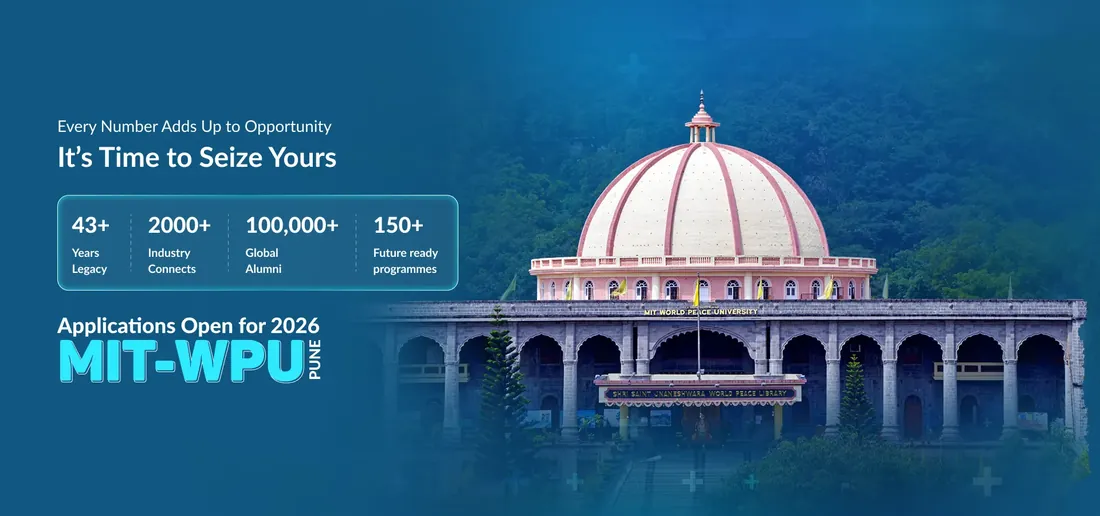
The Kothrud campus is the landmark one — the central dome and the Shri Saint Jnaneshwara World Peace Library are the images most people recognise. Kothrud itself is one of Pune’s better-connected neighbourhoods, on PMPML routes and within reach of Bavdhan, Karvenagar and the Hinjewadi corridor, which matters for internships more than it does for classes.
Because the campus sits in a dense residential area, hostels are spread across Kothrud, Karvenagar, Bavdhan, Ambegaon and Senapati Bapat Road, and the university lists a student shuttle between hostels and campus among the standard hostel amenities, along with 24x7 security, CCTV, biometric entry, RO drinking water, Wi-Fi, laundry, housekeeping and recreation rooms. Hostel food is vegetarian and prepared in a centralised kitchen. Two-wheeler parking is first-come, first-served. The university also runs an Innovation and Entrepreneurship centre, a technology business incubator and student clubs across technical, cultural and social domains — the detail of which clubs are active in any given year changes, so ask current students rather than trusting a list.
Career Development and Training at MIT-WPU
Placement and training run through CIAP and its Career Development Centre. The Placement Brochure 2025-26 reports the training operation at 10,000+ students trained across 350+ training batches, 250+ company-specific training programmes and 50+ trainers, covering aptitude, soft skills, group discussion and interview preparation, plus career counselling and alumni networking. The same brochure reports the highest internship stipend for the 2026 batch at ₹1,42,500.
Read the training numbers for what they are: they describe how much preparation is offered across the whole university, not how many engineering students were placed or at what salary. The outcome numbers are the ones in the placements section above, and the honest headline among them is the ₹6.30 LPA average.
Official source: MIT-WPU PLACEMENT BROCHURE 2025-26, pages 2, 5 and 7 (mitwpu.edu.in/uploads/images/Placement-Brochure.pdf); MIT-WPU Student Housing Manual 2026-27, pages 3 and 5, for hostel amenities and the dining policy; mitwpu.edu.in/about-us/history-legacy for the 1983 founding. All re-checked 11 September 2026.
MIT-WPU Pune — Frequently Asked Questions
MIT-WPU Pune — Extended FAQ: the Awkward, Specific Questions
The questions an aggregator will not answer, because answering them needs the actual documents.
Sources
Every figure on this page traces to one of these documents. Each MIT-WPU document was opened and re-checked on 11 September 2026; each is reissued periodically, so check the academic year printed on the document itself before you rely on it.
- MIT-WPU Admission Policy 2026-27 — branch-wise fee and intake annexure (p. 74), MBA fee annexure (p. 76), merit-scholarship seats (p. 57) and B.Tech scholarship percentile thresholds (p. 58), application fee (p. 14), instalment and penalty schedule (p. 86). mitwpu.edu.in/uploads/images/Admission-Policy-for-AY-2026-2027.pdf
- MIT-WPU Admission Rule Book, First Year B.Tech [After 12th], A.Y. 2025-26 — selection process and the allotment-round statement (p. 11), eligibility criteria (p. 9), reservation percentages (p. 6), Seat Acceptance fee (pp. 5 and 14). mitwpu.edu.in/uploads/events/press/FY-BTech-ADMISSION-RULE-BOOK-2025-26.pdf
- MIT-WPU Student Housing Manual 2026-27, re-issued 19 August 2026 (Registrar’s message dated 18 December 2025) — hostel fees for academic session 2026-27 (p. 4), capacity and amenities (p. 3), mess and dining policy (p. 5). mitwpu.edu.in/uploads/images/Hostel-Manual-Aug-26-27.pdf
- MIT-WPU Placements page — “2026 Placement Highlights (Ongoing)” and the premium-recruiter list. mitwpu.edu.in/placements
- MIT-WPU Placement Brochure 2025-26 — season statistics (p. 6), current-batch highest CTC and internship stipend (p. 7), branch-wise named offers (pp. 12–14), CIAP partner and recruiter counts (p. 4), training statistics (p. 5). mitwpu.edu.in/uploads/images/Placement-Brochure.pdf
- MIT-WPU Ranking & Accreditation page — NIRF 2025 bands, Pharmacy rank, the two 2025 engineering-institute ranking lines (printed there without a ranking body) and the list of recognitions. mitwpu.edu.in/about-us/ranking-accreditation
- MIT-WPU B.Tech admissions microsite — specialisation list, programme-wise fees, eligibility, selection criteria, the 19 August 2026 last date and the “Applications Closed” notice that has replaced it. admissions.mitwpu.edu.in/btech
- MIT-WPU B.Tech programme pages — the “Fee Per Year” each page now prints (₹4,30,000 / ₹3,85,000 / ₹3,15,000, no academic year given) and the scholarship “Terms & Conditions”: first-come, first-served, 8.0 CGPA, 80% attendance. mitwpu.edu.in/programme/btech-computer-science-and-engineering and sibling programme pages
- MIT-WPU CET 2026 page — the programmes MIT-WPU CET actually covers. mitwpu.edu.in/mit-wpu-cet-2026
- Maharashtra State CET Cell CAP records — official CAP Round I 2026-27 Open closing percentiles, with CAP 2025 Round 1 for comparison, used for the VIT Pune, PCCOE, DYPCOE and COEP rows in the comparison table, and circular 2187 of 7 September 2026 fixing 14 September 2026, 5:00 PM as the final date for technical-education admissions in Maharashtra for A.Y. 2026-27. The statement that MIT-WPU has no CAP cutoff is checked against the CET Cell’s Cut Off List for Maharashtra & Minority Seats of CAP Round I and CAP Round II, First Year Four Year Degree Courses in Engineering and Technology, 2026-27: MIT World Peace University appears in neither, while MIT Academy of Engineering, Alandi appears in both under college code 06146. cetcell.mahacet.org
Not used, deliberately: college-listing aggregators. Where they disagree with the documents above — on MIT-WPU’s cutoff, on MIT-WPU CET as a B.Tech route, on hostel rates — the documents win. Found an error? Tell us.
Get Free Guidance on MIT-WPU Admission
MIT-WPU’s application is straightforward; the decision around it is not. If you already hold a seat, the questions now are finishing document verification before 30 September 2026, planning the second instalment before 20 October, and which hostel is worth its distance. If you are planning for 2027-28, they are whether your percentile clears a scholarship band, whether a CAP seat is realistic for you, and which branch the money actually favours. FindUrCollege counsellors work through them with you, help with the 500-word Statement of Purpose and the document set, and do it free of charge to the student.
Talk to a FindUrCollege counsellor on WhatsApp · +91 91126 50438 · Get Free Counselling