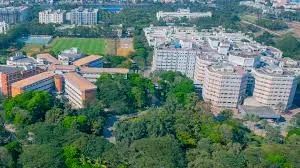
Sri Ramachandra Medical College & Research Institute (SRMC&RI) is at Porur on the western edge of Chennai, and is the medical college of Sri Ramachandra Institute of Higher Education and Research (SRIHER), a deemed-to-be university. The NMC first permitted it in July 1985; today it holds 250 MBBS seats, all allotted through MCC, and ranks 21st in the country on NIRF's 2025 Medical list.
Published 18 June 2026 · Updated 24 August 2026 · By Krishna Pandey, Founder & Lead Counsellor
✅ Sourcing: figures use official counselling records (MCC/state) and institute circulars — cutoffs change every round; reconfirm at allotment. No cash payments; official receipts only.
Quick Answer SRMC is the medical college of SRIHER, a deemed-to-be university at Porur, Chennai, so all 250 MBBS seats — 212 self-financed merit and 38 NRI — are allotted through MCC at mcc.nic.in, under college code 200396. SRIHER's own programme page puts the fee at ₹35,00,000 a year for 4½ years plus a one-year internship. In MCC Round 1 (provisional) 2026 the merit seats opened at AIR 2,780 and closed at AIR 329,861, with all 212 taken; 20 of the 38 NRI seats went. SRIHER is ranked 21st on NIRF 2025 Medical with a score of 61.54.
Sri Ramachandra Medical College, Chennai — campus (official)
📊 Sri Ramachandra Medical College Chennai — Key Facts 2026
Parameter
Detail (2026)
Institute name
Sri Ramachandra Medical College & Research Institute (SRMC&RI), Porur, Chennai. MCC lists a separate Sri Ramachandra Dental college at the same address — they are different institutes, so match on the full name.
Institute type
Non-government, trust-run, and the medical college of a deemed-to-be university. Not a government college and not a Tamil Nadu state-quota college — there is no state or AIQ seat here.
Parent university
Sri Ramachandra Institute of Higher Education and Research (SRIHER), Deemed-to-be-University, Porur, Chennai
Established
NMC establishment Letter of Permission dated 24 July 1985. The last sanctioned seat increase was permitted on 30 June 2011.
Location
No. 1 Ramachandra Nagar, Porur, Chennai 600116, Tamil Nadu
Degree offered
MBBS — SRIHER's own programme page states the duration as 4½ years plus one year of compulsory rotatory resident internship
Exam accepted
NEET-UG 2026 only. There is no institute entrance test and no state CET route.
MCC college code
200396. Search the MCC seat matrix by this code — the name alone will also return the dental college at the same Porur address.
Seats
250 sanctioned, split 212 self-financed merit + 38 NRI. The two rows account for the whole intake; there is no All-India-Quota row and no state row.
Admission
NEET-UG qualification mandatory, followed by MCC centralised Deemed/Paid + NRI counselling at mcc.nic.in. No state-quota or offline 'direct' route; seats are allotted only through MCC rounds (R1, R2, R3, Stray).
Fees 2026-27
₹35,00,000 per year, as published on SRIHER's own MBBS programme page. That page states a programme fee only — it does not publish a head-wise break-up, a hostel tariff or a separate NRI tariff, so none is quoted here.
Cutoff
MCC Round 1 (provisional), 2026: merit seats opened at AIR 2,780 and closed at AIR 329,861, all 212 filled; NRI opened at AIR 389,274 and closed at AIR 983,126, 20 of 38 filled. Round 1 closes at the toughest ranks of the cycle.
Teaching hospital
Sri Ramachandra Medical Centre, Porur, on the same campus — 1,700 beds including 30 emergency beds in the NMC register (ABDM facility ID IN3310000245)
NIRF
Medical: rank 21 in 2025 (score 61.54), down from rank 20 in 2024 (61.62). Universities: rank 60 in 2025 (51.35). The rank belongs to SRIHER, the university — not to the medical college alone.
Official website
sriramachandra.edu — the MBBS programme page carries the current per-year fee
Official sources for this table: SRIHER programme page “MBBS (Bachelor of Medicine & Bachelor of Surgery)”, Fees Structure section (sriramachandra.edu/programme/mbbs-bachelor-of-medicine-bachelor-of-surgery), captured 24 August 2026; MCC “Seat Matrix for NEET-UG Counselling 2026”, ref U-12021/02/2026-MEC, 5 August 2026, pages 16–17; MCC “Provisional NEET-UG Counselling Seats Allotment 2026 — Round 1”, 21 August 2026; NMC/MARB “Seat Matrix as on 29.10.2025 (MBBS) for the AY 2025-26”, N-15029/09/2025-UGMEB, row 594; the NMC MSMER college pro-forma; and NIRF 2024 and 2025 rankings at nirfindia.org.
Sri Ramachandra Chennai (SRIHER): Campus, Affiliation and NMC Recognition
SRMC&RI is at No. 1 Ramachandra Nagar, Porur, on the western edge of Chennai. The NMC register dates its establishment Letter of Permission to 24 July 1985, and records the last permitted seat increase on 30 June 2011. It is classed as a non-government college, and it is the medical college of Sri Ramachandra Institute of Higher Education and Research (SRIHER), a deemed-to-be university.
That deemed status is the practical fact for an applicant, because it decides the counselling: a deemed university has no state quota and no All-India Quota, so its whole intake sits in MCC's deemed stream. The teaching hospital, Sri Ramachandra Medical Centre, is on the same campus rather than at a distance — which is what makes daily clinical rotation possible from the early years.
Official source: NMC MSMER college pro-forma (college code srmcriche), fields for establishment LOP, increase-of-seat LOP and college type — captured 24 August 2026.
NIRF Rank: Where SRIHER Actually Sits
In one line: SRIHER is ranked 21st in India on the NIRF 2025 Medical list, with an overall score of 61.54.
NIRF list
Rank
Score
Reading note
Medical 2025
21
61.54
The figure to quote for the medical college
Medical 2024
20
61.62
One place better a year earlier — the movement is small, not a decline worth reading into
Universities 2025
60
51.35
A different list with a different peer set; not comparable with the Medical rank
Official source: Ministry of Education, National Institutional Ranking Framework, nirfindia.org/Rankings/2025/MedicalRanking.html and /2024/MedicalRanking.html and /2025/UniversityRanking.html, institute id IR-D-I-1486 — captured 24 August 2026.
What the score is made of, and why it matters here. NIRF publishes the five parameters behind the total, and SRIHER's 2025 Medical set reads: teaching, learning and resources 77.17, research and professional practice 39.19, graduation outcomes 88.84, outreach and inclusivity 64.79, and perception 23.82. So the 61.54 is carried by teaching resources and graduation outcomes, while research and reputation sit well below. If research output is what you want from a medical school, the headline rank overstates this one; if it is teaching infrastructure and completion, it understates it. A rank quoted with no parameters behind it cannot tell you which.
One more distinction people get wrong: the rank belongs to SRIHER, the university — it is not a rank for the medical college alone and not a rank for the hospital. Comparing it against a standalone college's medical rank is fair; comparing it against a university-category rank is not.
Sri Ramachandra MBBS Fee Structure 2026-27
In one line: SRIHER publishes one figure for MBBS — ₹35,00,000 per year — and nothing else.
The fee sits on SRIHER's own MBBS programme page under the heading “Fees Structure”, in a field labelled “Program Fees Per Year”. The same page gives the duration as 4½ years plus one year of compulsory rotatory resident internship.
What is not published, and should not be guessed at. That page states a programme fee and stops. There is no head-wise break-up, no hostel tariff, no mess figure, no caution deposit and no separate NRI tariff on it — so every one of those is not listed here. Dollar totals for the NRI quota and rupee hostel rates for this college do circulate, and they are worth exactly what an unsourced number is worth when the sum involved is above a crore. Ask SRIHER's admissions office for the written 2026-27 fee schedule, which is the document a bank will want anyway.
Read the per-year figure carefully. It is per year, not for the course, and the programme runs 4½ academic years — so the tuition commitment is on the order of four and a half of these instalments, not four and not five. Nothing on this page should be multiplied out and treated as a final payable total: it excludes whatever the hostel, mess and deposits turn out to be, and it is not a projection of future fee revisions. Compare it against other deemed colleges in our deemed-university MBBS fees page, and see the education loan guide for how a fee of this size is actually financed.
Seats and the NRI Quota
In one line: 250 seats, split 212 self-financed merit and 38 NRI — and MCC states the split outright, so it does not need estimating.
The MCC seat matrix for 2026 lists SRMC&RI under college code 200396 with a total sanctioned intake of 250 and exactly two quota rows: 212 Self-Financed Merit Seats and 38 Non-Resident Indian seats. The NMC seat matrix independently records 250 seats for both AY 2024-25 and AY 2025-26, so two regulators agree on the intake.
The NRI seat is open to NRI, OCI and PIO candidates, and to Indian students sponsored by a first-degree NRI relative under the Supreme Court norms, where the sponsor formally undertakes the fee. The academic gate is identical for both quotas: a qualified NEET-UG scorecard. No fee tier and no quota can place a candidate below the qualifying percentile, and anyone offering that is offering a fraud.
Official sources: MCC, “Seat Matrix for NEET-UG Counselling 2026” (tentative), ref U-12021/02/2026-MEC, 5 August 2026, pages 16–17; and NMC/MARB, “Seat Matrix as on 29.10.2025 (MBBS) for the AY 2025-26”, N-15029/09/2025-UGMEB, row 594 — both captured 24 August 2026.
Sri Ramachandra NEET Cutoff 2026 — MCC Round 1
In one line: the merit seats opened at AIR 2,780 and closed at AIR 329,861 with all 212 taken, and the NRI seats closed at AIR 983,126 with 20 of 38 taken.
Quota
Opening AIR
Closing AIR
Seats allotted
Reading note
Self-financed merit (Open)
2,780
329,861
212 of 212
An opening rank inside the top 3,000 — this college draws genuinely strong candidates at the head of the queue
Non-Resident Indian (Open)
389,274
983,126
20 of 38
18 NRI seats went unfilled into Round 2
Official source: MCC, “Provisional NEET-UG Counselling Seats Allotment 2026 — Round 1”, published 21 August 2026, for institute “Sri Ramachandra Medical College & Research Institute, Chennai, No. One Ramachandra Nagar, Porur, Chennai” — captured 24 August 2026.
How to read this without being misled. The figures are provisional and Round 1 only, and Round 1 always closes at the toughest ranks of the cycle — Round 2, mop-up and stray vacancy close at higher numbers. They are All-India MCC ranks, not a Tamil Nadu state-counselling cutoff, and there is no state cutoff here to compare them with. And a closing rank is the last rank allotted, not a qualifying bar: the legal gate is your NEET-UG percentile.
The number that actually distinguishes this college. An opening rank of 2,780 on a self-financed seat is unusual. Candidates with ranks that would reach many government colleges chose to pay for a seat here, which is a demand signal no fee table or ranking shows you. Set it against a comparable MCC deemed college: RajaRajeswari in Bengaluru opened at AIR 147,550 in the same round and the same counselling. Same stream, same rules, roughly 145,000 ranks apart at the top of the queue.
In one line: 1,700 beds, on the same campus as the college.
The NMC register records the college's associated teaching hospital as SRIHER, with 1,700 total beds and 30 emergency beds, under ABDM facility ID IN3310000245. That is the regulator's figure, and it is the one to use when comparing colleges — ICU counts and operating-theatre counts for this hospital are not stated in that register, so they are not listed here.
Bed strength is a proxy for case volume, and case volume is what clinical competence is built on: a busy tertiary hospital rotates an undergraduate through a wider pathology mix than a low-occupancy one with the same licence. Beyond the main hospital, MBBS students take community-medicine postings at the institute's rural and urban health training centres, which is the breadth the NMC competency-based curriculum expects. The compulsory rotatory internship runs for a year after final MBBS.
Official source: NMC MSMER college pro-forma (college code srmcriche), Associated Hospital Details — captured 24 August 2026.
The Harvard Connection, In Proportion
SRMC is often described as having a Harvard link. What existed was a collaboration with Partners Harvard Medical International, the international arm associated with Harvard Medical School and Partners HealthCare, tied to a healthcare-quality and hospital-operations programme around the institution's international-accreditation era. That is a genuine credential and it says something real about the institution's quality orientation.
What it is not: an ongoing exclusive alliance, an admission advantage, or any form of degree equivalence. It confers none of those, and a page implying otherwise is selling something. If the collaboration's current status matters to your decision, ask SRIHER for it in writing rather than relying on a summary of a programme from another decade.
Practising Abroad After an SRMC MBBS
An SRMC graduate can pursue USMLE, PLAB and the equivalent licensing routes for Ireland, Australia, Canada and the Gulf — but that eligibility comes from the college being NMC-recognised and listed in the World Directory of Medical Schools, exactly like every other recognised Indian medical school. It is not an SRMC-only status. Claims that this degree is uniquely “GMC UK recognised” describe the ordinary WDOMS position in flattering language. The host country's licensing exam always applies, and no Indian MBBS grants automatic registration anywhere abroad.
How to Apply to SRMC in 2026
Step 1 — qualify NEET-UG 2026. Your scorecard must read eligible for your category; nothing else opens any of these seats.
Step 2 — register with MCC at mcc.nic.in for the deemed/paid and NRI counselling, and find the college by code 200396 rather than by name — the dental college at the same Porur address will otherwise appear alongside it.
Step 3 — pick the right quota before choice-filling. Merit and NRI are separate rows with separate ranks. In 2026 the merit row filled entirely while 18 of 38 NRI seats stayed open, so genuine eligibility for the NRI quota changes the odds more than choice order does.
Step 4 — report and pay through official banking channels within the stipulated window, after biometric and document verification.
The document set is the standard MCC one, including the NRI sponsor's passport, visa, embassy certificate and sponsorship affidavit — the full checklist lives on our documents for counselling page rather than being repeated here. There is no offline route into this college, no management quota outside MCC and no agent-controlled seat.
Bond, Stipend and the Costs Nobody Publishes
Two things families ask about, and the honest answer to both is the same.
Internship stipend: not listed. SRIHER does not publish an internship stipend on its MBBS programme page, and it is not stated in the NMC register entry for the college. Figures circulate; none of them comes from the institution.
Service bond: not listed. No bond term is published on the college's own MBBS page. Whether one applies, and on what terms, belongs in your admission letter — a bond is a contract, so read it there and not in any summary, including this one.
What to budget beyond tuition. Hostel, mess, books and equipment, and any deposits — none of which SRIHER publishes a figure for. Ask admissions for a written, line-itemed 2026-27 cost sheet including any year-on-year escalation before you commit. At a fee of ₹35,00,000 a year, the unpublished items are the ones that decide whether your loan sanction is enough.
Eligibility for SRMC
Entry rests on the national NMC rules — 10+2 with physics, chemistry and biology, the NEET-UG qualifying percentile for your category, and the minimum age. They are the same at every MBBS college in India and are set out in full on our MBBS admission guide and NEET 2026 pages.
SRIHER states its own version on the MBBS programme page: a pass in H.S.C. or equivalent with a minimum 50% (40% for SC/ST/OBC) taken together across physics, chemistry and biology or botany and zoology, plus a pass in English, and not less than 50% (40% for SC/ST/OBC) in the entrance examination. There is no domicile condition, because there is no state quota. The NRI seat adds documentary requirements about the sponsor, not a different academic bar.
Where Free Counselling Helps at SRMC
A seat here cannot be bought, and the merit row filled in Round 1. What guidance changes is whether you are in the right quota, holding a realistic view of a rank that opened at 2,780 — and whether you have the written cost sheet before you commit to a fee SRIHER publishes only as one annual number.
Collateral thresholds, moratorium terms, bank comparisons and the government post-matric schemes are covered properly in our MBBS education loan guide. The point specific to SRMC is the sanction arithmetic: ₹35,00,000 a year across 4½ academic years is among the higher published MBBS tuitions in the country, and the hostel, mess and deposits sit on top of it without a published figure. Sanction against the written cost sheet, not against the programme-page number alone.
After the MBBS
The routes onward — NEET-PG and INI-CET, DNB, government service, or the overseas licensing exams — are the standard ones, and our NEET-PG 2026 guide covers them. What is specific here is that SRIHER is a full deemed university whose own site lists fifteen constituent faculties — medicine, dentistry, pharmacy, nursing, engineering, allied health and more — each running its own postgraduate programmes, and its NIRF graduation-outcomes score of 88.84 is the strongest of its five parameters — completion and progression are where this institution measures well.
❓ Frequently Asked Questions — Sri Ramachandra Medical College Chennai 2026
250 sanctioned MBBS seats, split into 212 self-financed merit seats and 38 NRI seats. MCC lists both rows under college code 200396 in its Seat Matrix for NEET-UG Counselling 2026 (ref U-12021/02/2026-MEC, 5 August 2026), and the two together are the whole intake - there is no All-India-Quota row and no Tamil Nadu state row, because SRMC belongs to a deemed university. The NMC seat matrix independently records 250 seats for AY 2024-25 and AY 2025-26.
SRIHER publishes one number for MBBS: ₹35,00,000 per year, in the Fees Structure section of its own MBBS programme page, in a field labelled Program Fees Per Year. The same page gives the duration as 4.5 years plus a one-year compulsory rotatory resident internship. It does not publish a head-wise break-up, a hostel tariff, a mess figure, a caution deposit or a separate NRI tariff, so each of those is not listed - ask SRIHER admissions for the written 2026-27 cost sheet. Captured 24 August 2026.
Qualify NEET-UG 2026, then register with MCC at mcc.nic.in for the deemed/paid and NRI counselling. As a deemed-university college SRMC has no state quota, no All-India Quota and no offline direct route; every seat is allotted through the MCC rounds. Look the college up by code 200396 rather than by name, because MCC also lists a separate Sri Ramachandra dental college at the same Porur address.
In MCC Round 1 (provisional) 2026, the self-financed merit seats opened at All India Rank 2,780 and closed at 329,861, with all 212 allotted; the NRI seats opened at 389,274 and closed at 983,126, with 20 of 38 allotted. Round 1 closes at the toughest ranks of the cycle, so later rounds close at higher numbers. An opening rank inside the top 3,000 is the unusual figure here - it means candidates who could reach government colleges chose a paid seat at this one. Source: MCC, Provisional NEET-UG Counselling Seats Allotment 2026 - Round 1, published 21 August 2026.